Showing posts with label feminism. Show all posts

Twenty Hobbies

Feb. 16, Sixth Sunday in Ordinary Time.


I stole this quote from Sarah of Little Progress Notes, and even though I have read it before, it stuck in my flesh like a thorn, sharp, sweet, and chastising, as it did the very first time I read it.  Someone close to me was very upset by this quote at the time, and I couldn't understand why.  Not intellectually.  Intellectually, I could understand how someone, a woman, who aimed for a profession or the perfection of a trade would balk that Chesterton thinks she oughtn't.  But my heart cannot fathom it.

When I read this quote, it's like if someone handed me a translation guide to the language of my soul.  People talk about wanting to be stay-at-home moms, and the majority of that talk revolves around the raising and education of children--which is, obviously, the most important aspect of homemaking if you're blessed to have them.  But there's more to it than that, and I see the fruits of the domestic woman in those who are not able to have children.  They're free to perfect their skills and passions.  They're broadly educated, not necessarily formally.

My own mother is extremely well-informed about current world events; her relatives in high political places talk down to her "narrow" point-of-view and are abruptly put in their place by a southern housewife.  I have a friend university-bound after seventeen years of graduating high school; she speaks with more lucidity and grace than most of my college professors.  My godmother has helped her husband raise the children from his first marriage, run three successful businesses, and start a grassroots ministry addressing the sorely ignored crisis of human sex trafficking.  My favorite women bloggers are, by a landslide majority, homemakers; more than gifted writers, they are photographers, crafters, architects, chemists, seamstresses, artists, philosophers, poets, botanists, activists, farmers, chauffeurs, and cooks.  They're quite literally everything to someone (their families).  And it just wouldn't be possible for them to be that astonishingly versatile in a career.

It's very telling that after a century of liberation, women are choosing to go back to the professions (oppression?) of their great-great-grandmothers.  Instead of being taught in an unbroken chain of mother-to-daughter lore, they're having to re-learn many of those skills that made suppressed Woman so dangerously skillful.  I suppose the feminist movement was necessary because it helped us understand.  For now we have the double benefit of having the freedom to choose and choosing not to be "free."

As for myself, being a Catholic, I have no problem being told what I ought to do and what is good for me.  But then, I believe that the so-called restraints of the patriarchy are not man-made at all, but transcend the world.

I don't think that a woman can't be focused on a single aim to forge a career.  Or that some women are best suited to that lifestyle.  I just know that in my first-hand experience with competent, thoughtful women, and for me personally, that would be sad.  It would be a kind of compromise.

I have so much to offer, so much that I'm passionate about.  God has generously equipped me.  I don't care that my ability to make a dwelling a comfortable home, or the home a place of spiritual peace and healthful stimulation, will go unappreciated by society.  And I grow weary of rationalizing my "career" preferences to that same society.  Like if I don't chose something concrete to achieve and then run it down like a fox, I'm irresponsible or somehow mis-made.  I feel, when I tell the world that I wish not to work formally for a living, a reaction akin to sexism.  If I can chose a lifestyle, God willing--and not without knowledge and acceptance of the sacrifices, as well as the blessings--in which I need not be distracted by the minutiae of the outside world, then that is what I want.  Because this is not a useless, fruitless aim.

Chesterton's logic gives me permission to embrace the scattered person I am; and he gives me comfort by telling me my efforts are not vain, nor shameful.  The domestic woman is unimpressed by the limp equality offered by a world that seeks excellence at the expense of freedom, that considers seclusion oppression and liberality narrow.  Our role model for Womanhood is a virgin and a mother--a handmaid and a queen.  And the domestic woman is the original Renaissance Man.


Thanks to Sarah of Amongst Lovely Things for hosting Weekends with Chesterton.

sig

What Women Really Need for Valentine's Day

Feb. 14, Feast of St. Valentine, bishop and martyr.


to know there is hope after abortion #ProjectRachel  //  a society that doesn't force them to choose freedom at the expense of their children  //  not to be murdered in the womb for being the wrong gender


I'm a one-issue voter.  It's hard for me to imagine funneling energy into other issues if we can't first secure the right to life.  Without life, all other rights are rendered obsolete.  I believe that if a politician, public figure, or party endorses abortion, it's a deal-breaker.  That said, the fight for life shouldn't end at birth.  The sidewalk counselors oughtn't to wipe their hands of the women they just talked out of a permanent decision--praise be to God!  That first, initial victory over death is only one of many, many more battles.  The culture of death is called a culture because it permeates everything.  It's in our attitudes, our visions of beauty, our food and clothing choices, our entertainment.  Our work isn't done as soon as the innocent child is born alive.  It should only have begun.

I have struggled in this culture of death.  I was naive when I married, and almost certainly not ready (having nothing whatsoever to do with my actual age and everything to do with psychological maturity).  I found myself pregnant three months later, after a very rocky initiation into real life.  We had no work, no means of income, and no hope for either of those two things to change in the foreseeable future.  People I loved and cared for, people whose opinions mattered to me, said all the right, "pro-life" things, but I could hear their internal head-shaking as loudly as if they were screaming at me.  Acquaintances gave me sideways glances at Mass.  My mother cried.  I felt like an unwed-and-pregnant, teen-aged high school drop-out.  Never mind that I had a Master's degree and was validly married in the Church.

It was my father--my stern, pull-yourself-up-by-the-bootstraps father--who silenced all further woebegone what-might-have-beens with a single sword-like sentence: "We welcome all life in this house."

But that wasn't the end of hardship.  I had terrible, day-long morning sickness.  I lost weight.  After two and half days of keeping nothing down, not even water, I was so weak and miserable I dragged myself to the emergency room to have anti-nausea meds pumped into my through an IV.  When the sickness subsided, the preeclampsia set in.

When my baby was born, I suffered severe post-pardum depression; anemia; recurring UTI's; inexplicable and disabling body aches.  My son never slept; my husband couldn't take care of him; my parents, whom we had moved in with, were overtaxed and overworked.  They were frustrated with the added burdens.  I was weak and exhausted and emotionally a wreck and without health insurance.  My husband worked a minimum wage job part-time hours.

Fast forward two years.  We moved into a tiny but affordable apartment.  My husband managed fairly well at a better-paying job for a short period of time, the job the vocational rehabilitation department got for him.  After six bounced checks; gasoline poured, libation-like, into the hour-and-a-half long one-way commute (I drove, my husband didn't have a license and we couldn't afford to add him to insurance) only to be told, "We're taking the day off today, go home;" and manipulating him into saying he was quitting so they didn't have to pay unemployment, my husband booked a one-way-ticket back to his home country.  I worked a minimum wage job, and only just found a part-time something that paid a little better in September.  My husband sends us money when he can.

Today, we are incredibly blessed.  We have food, shelter, and happiness.  It took us a long time to finally get here, but we did.


Yesterday, my little boy turned 3 years old.  If society had it's way, he wouldn't be alive.  Why is that?  Why is it that it's easier for Planned Parenthood to grab a fistful of money and cut up a perfectly formed human being than it is for our communities to offer positive support, giving dignity to the whole woman, as well as her baby?  What are we doing to make sure life is treated--before and after birth--as the sacred, worthwhile thing it is?

Whatever we do to improve the lives of all human beings, women included, it starts with the womb.  Let's just make sure it doesn't end there.

". . . If we could see the stars as a child sees them, we should need no other apocalypse. . .  But the influence of children goes further than its first trifling effort of remaking heaven and earth.  It forces us actually to remodel our conduct in accordance with this revolutionary theory of the marvelousness of all things.  We do actually treat talking in children as marvelous, walking in children as marvelous, common intelligence in children as marvelous. . . [and] that attitude towards children is right.  It is our attitude towards grown up people that is wrong. . ."--G.K. Chesterton
sig

Monologues and Dialogues

Eugene Delacroix
{Before reading this post, please note there are accurate references to female anatomy and sexuality.

Please also note: I've never read or seen The Vagina Monologues, so my impressions are solely from hearsay.}

Now, I've never read The Vagina Monologues, but my friends are very fond of it.  From their descriptions of it, TVM empowers women by airing out, bluntly, with no apologies, issues of abuse, sexuality, and body image which are neglected because of the discomfort of the subject--perhaps even because it opens up the chance for females to think autonomously.  I'm not so naive to believe that sexism has been eliminated from the face of the earth.  The beauty of TVM is that it shows women that, far from something to be ashamed of, their sexuality is something to be celebrated.  I whole-heartedly agree.

Despite this, I have a niggling sense of reservation about The Vagina Monlogues and the (I've no doubt) noble movement behind it.  Curious as to where this doubt was coming from in myself, I thought about it for a while.  I think I've come to a conclusion, and I'd like to share it with you.  The reason I am uncomfortable with female sexuality as it is taught to be viewed in TVM, is this.


The "I" Factor


It seems to me that this kind of sexuality is heavily dependent on the "I."  Self-love and self-respect are necessary, praiseworthy.  But too much of a good thing becomes poisonous.  It bleeds over into (clinical term) narcissism, a god-like complex in which one views oneself as the center of reality, as a litmus test by which everything is governed.

I'm thinking of the attitude that often says

"As long as I'm not hurting anyone, it's okay."  
"This is good for me/I like this/this is easy, therefore it is good for me."  
"All that matters is that I am happy."  

As opposed to the attitude that says

"Is this good for my children, my spouse?"  
"Is this good for the environment?"  
"Is this good, not only for my immediate needs, but for the long term well-being of my soul, my health, and my happiness?"

Perhaps our American attitude has a lot to do with this over-autonomy.  We won't be bossed around, dammit, and you can take your outrageous tea taxes with you!  (Shakes fist.)  I'm not trying to say that the human person isn't a creation of astounding rationale and a dignity that is inherent, regardless of race, culture, creed, religion, mental capacity, disability, age, class, and location.

I mean the simple yet beautiful doctrine of the Beatitudes.  The last shall come first.  The first shall come last.

You must lose yourself in order to find it.


Love as Dialogue


There is more than one way to masturbate.  One, obviously, is the literal-sexual way.  Another is to act in such a way, conduct oneself in such a way, as to please oneself, and only oneself.

Sexuality, I believe, is a profound and far from shameful thing, specifically designed to reach its fullness in another.  Post-modernism has taught us that to be dependent on another in such a way is degrading, even dangerous.  I'm not talking about co-dependency here.  Of course, a person who sees no worth in herself other than what another sees of her needs much healing.  I mean believing in something--God, a divinity, an abstract philosophy--that proclaims that one's worth is inherent, a reality outside of the thing that it is attached to.  The nun and the prostitute are equals.

This is truly the most liberating philosophy I have ever encountered.  Because nothing I do can possibly diminish my value.  

I am just that great.  And so are you.

From what I've gathered, The Vagina Monologues encourages women to look at their own vaginae (I assume using a mirror, like in The Color Purple).  This is self-knowledge, empowerment, claiming/taking back what is your own.  I think it's awfully close to navel-gazing.  Not necessarily a sin, mind you, though I fail to see it as the empowering act it is supposed to be.

But then, nothing beats discovering oneself through the eyes of utter love.

I will draw from my own experiences for example.  I've never had more self-esteem than when I was with my boyfriend, now husband.  He sees beauty in me unconditionally.  It was both surprising and liberating for me, that nothing I can do can expand on or diminish this simple fact.  I am beautiful.

If any sense of ugliness lingered, motherhood distinguished it.  This little human being, who is so, so wonderful in his own right, views me as the sun, the moon, and the stars.  This won't last.  He'll grow up to know that I'm not perfect.  But you know what?  He'll still love me.  By virtue of being me.  By the simple reality of being "mama."  Wow.  Makes me want to be the person he sees in me, to become a person truly deserving of such devotion.

I know I have value, but I don't need a mirror to prove it.  The mirror is in the eyes of my loved ones, and those few individuals who are blessed enough to see things as they really are . . . "saints and poets, maybe."

I see this self-respect heroically demonstrated by women all over the world.  I've known Muslim women who are passionately feminist.  They lock out every chance for a man to objectify them.  They cherish their beauty, and hide it close like a precious jewel, because they know it belongs to someone else.  I know a woman who, when cat-called from across the parking lot, confronted the man and demanded that he treat her with the same respect he would a fellow man.  This same woman, I'm sure, has never felt the need to look at her vagina.

This is the sense of empowerment, self-love, and dignity that I would wish for the women who love The Vagina Monlogues, for all women.  That they could behold them as I do, as God does: as things so utterly beautiful that self-love bends back on itself and ricochets  in every direction; ordered not toward the self but others; because they love themselves enough to know that loving themselves is not a closed-ended objective.  

It magnifies, toward infinity, so that we become mirrors to each other, content to reflect, over and over again, ad infinitum, in the dialogue of love.

Like, The Agape Dialogues.  <3

sig

Relevant resources:

Feminists for Life--empowering women so that they don't have to "choose"
Verily Magazine--positive fashion and feel-good beauty
Bad Catholic--profound insights into the nature of love and beauty; funny, too

Honest Illusions of Grandeur

Or, Why I Want to Be a Stay-At-Home Mom

"I would give a woman not more rights, but more privileges. Instead of sending her to seek such freedom as notoriously prevails in banks and factories, I would design specially a house in which she can be free." -- G.K. Chesterton, What's Wrong with the World

Chesterton published this in 1910, and even then it was not a popular view.  I can't imagine what is thought of it now.

I have been working for about a month now, and I do enjoy getting out of the house, and the satisfaction of a paycheck, and being able to socialize with coworkers and customers.  However, the experience has only affirmed my very old-fashioned feeling that God and nature have arranged it so that the ideal of maternal womanhood is to be a full-time, stay-at-home mom.*

There is something jarring about interrupting the everyday monotonies I share with my son to enter a different world entirely, and though it is in many ways easier to drop the baby off at my mother's and only have to worry about myself for awhile, I can honestly say my feelings now match my long-suspected beliefs.

You see, homemaking is not something I come by naturally.  I find it much easier to bang out a thesis, or read a book on politics, or answer telephones and take messages than to prepare two to three meals a day and pick up after the baby.
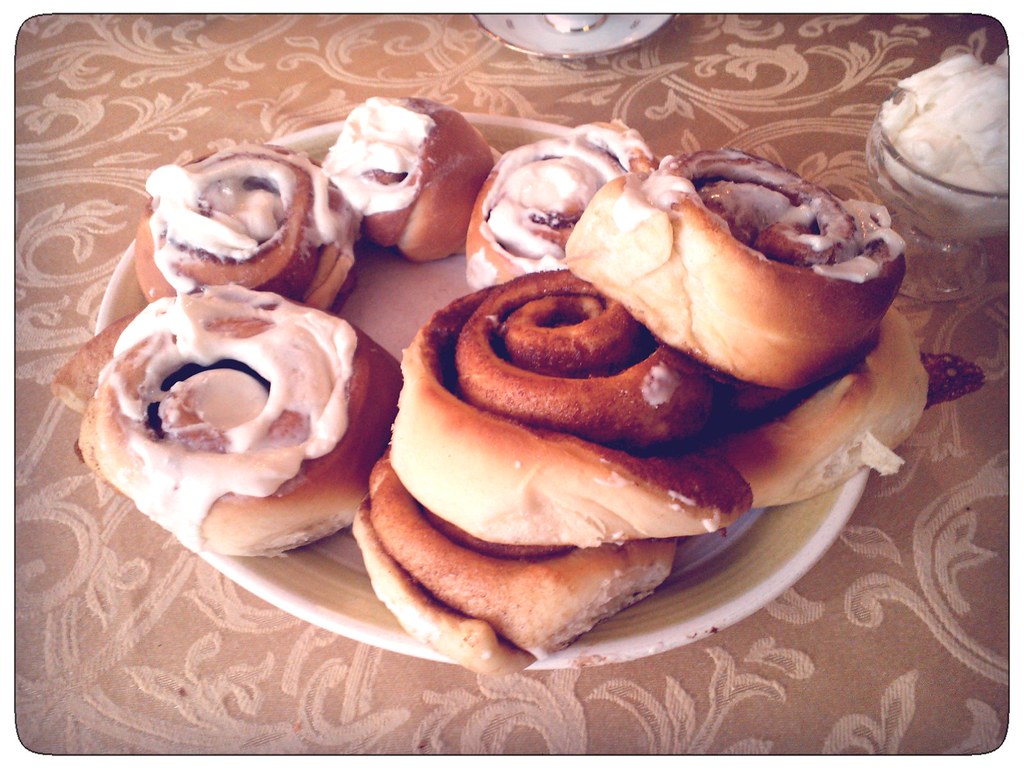
InstaCam_2012-07-06_04-02-13-PM
If I were a stay-at-home mom, I would think a lot about making cinnamon buns and other baked goodies.
I contest the modern notion that the woman who stays home to raise her child is sacrificing a life of dignity and freedom.  I believe I would thrive very well in the office of an adjunct professor on some dreamy college campus.  It is true that even a part-time job gives me a break away from the baby and a chance to earn money.  But I would find more dignity, more satisfaction, more peace staying at home with my son; in the way someone finds dignity, satisfaction, and peace in serving one's country at war.  Not because it is easy, or even necessarily the first vocation one would choose for oneself, but because it is Right.

It is about the Other, the Beloved, and placing his needs and desires before my own.  I want my son's earliest memories (the ones so far back they become only traces of feelings) to be full of a sense of security, of the assurance of my presence, my companionship, my love, and my attentiveness to him.

I want this because I believe it is right.  I believe it is right in the very way some modern feminists believe it is right for a woman to "have a life outside the home."  And I want it because it is right and not because I am lazy, timid, incompetent, or afraid to take on the world.

'Cause I'm pretty sure that I'm more suited to the opposite.

If I had the choice, what would I do?  I'd like to say that I would be a home-schooling mom for the next eighteen years**, and a productive one at that (!), but perhaps boredom and self-interest would drive me to work regardless.***  Especially by the time the baby becomes an independent adolescent, and less time is needed in looking after him and more time is free to clean the bathroom and sweep the kitchen.

Unfortunately, we do not live in a place and time where a single profession that earns enough to take care of a family is easy to find.


*  Exceptions not withstanding.  I believe there are some situations in which it suits the spouses and children best for the mother to work and the father to stay at home.  But the intrinsic natures of men and women generally fit better with the nurturer-vs.-provider model. 
**  I would be remiss if I didn't mention that to be true to this vision, I would be open to having many more children.
***  The third alternative to "productive, attentive housewife" and "working woman" is a sin to which I am especially vulnerable.  It would be very tempting for me to waste time say, reading Doctor Who fanfiction on the internet, making useless holiday crafts and decorations, or going window-shopping in antique stores, to avoid what I view as less entertaining, more productive work.  This is certainly not right either, and perhaps in that case, it would be better for me to make a productive contribution to society by holding down a job.


Dogs and Gravity

I'm going to pull a Chesterton and paraphrase a thought from a source whose name I do not remember.

The idea went something like this:

It is not counter-productive for women, in feminist literature, to do bad things and sometimes even to be portrayed as morally depraved.  Adherence to traditional patriarchal mores and ethics is another way that men subjugate and oppress women.  The character who neglects or abuse her children, betrays her lovers, and harms others for the sake of herself is one who is enlightened because she is free to explore an existence outside that which is expected of her.

My thoughts upon reading this were:

What?

It is the feminist point of view that women are constricted by man-made morals?  That's like saying that dogs are forced to stay on the ground by that antiquated, fowl-favorable, man-made Law of Gravity.

Our canine friends, who are aerially challenged, get together and determine the best way to overcome this obstacle is to ignore the Law of Gravity altogether and just do what they feel like.  Far from realizing their folly, they applaud the boldest of them that launch themselves from cliffs and jump from the roofs of doghouses with reckless abandon.  True, they're injured from their defiance and sometimes even killed, but darn it, at least they showed those close-minded anti-quadrupeds what's what.  And they've explored what it means to be dogs, not just what humans say it means.

Okay, I think I squeezed every last drop of usefulness-just-dodging-ludicrous out of that metaphor!

My paraphrase probably oversimplifies the author's original intentions, but it is an interesting thought nonetheless.  It reminds me of the often-dragged-out charge against Christianity that Christians have long subjugated women because they blame Eve for the Fall (and cite Augustine, as if infalible, to prove it), but smoothly overlook that

a)  Adam was complicit; it took the two of them to ruin Paradise.  When Adam tried to put the blame solely on Eve, God didn't let him.

b)  Mary the mother of Jesus gave life to the Child who would reverse the ill effects of the Fall and rescue us "poor, banished children of Eve."  She is probably the most revered and honored single woman of all time.  That's all.

Morals aren't man-made.  They are formed by natural law, as natural as the Law of Gravity.*  They can be found etched into the heart and soul of every person regardless of religious, ethnic, and geographical background.  You could even call it conscience.  And rebelling against that law, whether man or woman, exiles.  It doesn't free.  It's as simple and as difficult as this


versus this


Since I started with him, I'll give the last word to Chesterton:
"When I finally saw what was nobler than my fate, the freest and the hardest of all my acts of freedom, it was in front of a gilded and very gaudy little image of [Mary] in the port of Brindisi, that I promised the thing that I would do, if I returned to my own land."
 - - -
*Perhaps even more so.  For natural laws of science can be suspended, which is what a miracle is.  But to suspend conscience in a human being is to rob him of that which makes him human.  And yeah, I know that there's a fundamental difference between science and philosophy.  Don't read the dog-and-gravity metaphor too literally.