Dec. 10, Feast of Pope St. Miltiades (Melchiades). Tuesday of the Second Week of Advent.

I grew up acquainted with Santa Claus. Christmas Eve was better by far than even Christmas Day because the expectation and the ideal of the luxurious presents in colorful disarray beneath evergreen boughs was by far better than the reality--though that was pretty good, too! And what could have incarnated and represented this sweet expectation better than Santa Claus? That mysterious resident of Faerie, good-natured but not permissive, who defied all science (though not the logic of the human heart) and visited every single house in the world in one breathless night, bestowing gifts to good children in homage to the Christ Child?
I knew Santa was sometimes called Saint Nick, but I learned of the historical saint much later.
As I fell deeper in love with the Faith, I was tickled and proud that our own dear bishop should be the source and inspiration for my beloved childhood friend. Interest in foreign cultures and anthropology introduced me to many delightful traditions regarding Nicholas and Christmas--including the medieval liturgical celebration of his feast on December 6th, still observed in some European countries.
Meanwhile, Father Christmas, understood to be more or less Santa Claus's British counterpart, endeared me to him in the sacred stories of my adolescence. To this day, the phrase
"always winter, never Christmas" gives me delicious chills, causes me to crave Turkish delight, and attracts me to wardrobes.
Now my own son is coming of age, that holy age of unbridled imagination.
Last year, Father Christmas left him candy and presents in an over-sized stocking; last week, Saint Nicholas tucked sugared oranges and miniature candy canes into his little shoes.
I want to submerge him in the alternative lifestyle that is the Church calendar and teach him the mysteries of human story; for for me, the realm of Faerie and the Truth of the Faith are not mutually exclusive. On the contrary, I don't believe I could even approach one without the other.
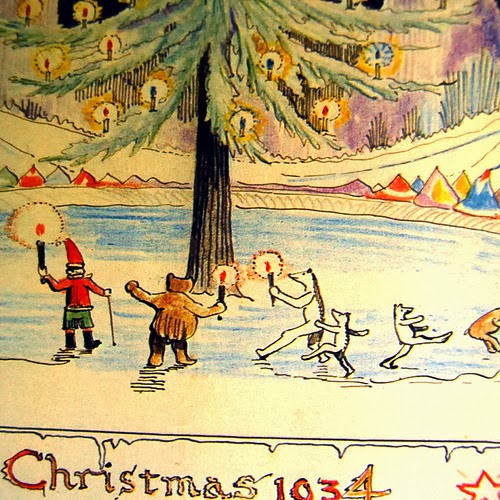 an illustration of Father Christmas at the North Pole by JRR Tolkien
So I was a little dismayed to read
this article on CatholicCulture.org, one of my favorite resources for liturgical living:
Many people think that Santa Claus is St. Nicholas "in disguise." Actually the two figures have nothing in common except the name.
That threw a wrench in my dewy-eyed, fanciful plans for integrating the magic of my childhood with the magic of the Incarnation. If Santa Claus is merely a sanitized, Protestant-scrubbed, secular shell of the real Saint Nicholas, how can I justify continuing the tradition that weakens the life-giving and salvific richness of the Catholic Faith? Yet I wouldn't deprive my own son of that poignant joy of Christmas that nurtured my imagination and cultivated my soul in preparation for greater mysteries. Who, indeed, says it better than Chesterton:
What has happened to me has been the very reverse of what appears to be the experience of most of my friends. Instead of dwindling to a point, Santa Claus has grown larger and larger in my life until he fills almost the whole of it. It happened in this way. As a child I was faced with a phenomenon requiring explanation. I hung up at the end of my bed an empty stocking, which in the morning became a full stocking. I had done nothing to produce the things that filled it. I had not worked for them, or made them or helped to make them. I had not even been good–far from it. And the explanation was that a certain being whom people called Santa Claus was benevolently disposed toward me. . . . What we believed was that a certain benevolent agency did give us those toys for nothing. And, as I say, I believe it still. I have merely extended the idea. Then I only wondered who put the toys in the stocking; now I wonder who put the stocking by the bed, and the bed in the room, and the room in the house, and the house on the planet, and the great planet in the void. Once I only thanked Santa Claus for a few dolls and crackers, now, I thank him for stars and street faces and wine and the great sea. Once I thought it delightful and astonishing to find a present so big that it only went halfway into the stocking. Now I am delighted and astonished every morning to find a present so big that it takes two stockings to hold it, and then leaves a great deal outside; it is the large and preposterous present of myself, as to the origin of which I can offer no suggestion except that Santa Claus gave it to me in a fit of peculiarly fantastic goodwill.
I think Chesterton would also agree that what the article on Catholic Culture finds distasteful is that which makes Santa endearing and recognizable in a profound way.
Behind the name Santa Claus no longer stands the traditional figure of St. Nicholas but the pagan Germanic god Thor (after whom Thursday is named). To show the origin of the modern Santa Claus tale let us give some details about the god Thor from ancient Germanic mythology.
Thor was the god of the peasants and the common people. He was represented as an elderly man, jovial and friendly, of heavy build, with a long white beard. His element was the fire, his color red. The rumble and roar of thunder were said to be caused by the rolling of his chariot, for he alone among the gods never rode on horseback but drove in a chariot drawn by two white goats (called Cracker and Gnasher). He was fighting the giants of ice and snow, and thus became the Yule-god. He was said to live in the "Northland" where he had his palace among icebergs. By our pagan forefathers he was considered as the cheerful and friendly god, never harming the humans but rather helping and protecting them. The fireplace in every home was especially sacred to him, and he was said to come down through the chimney into his element, the fire. (See H. A. Guerber, Myths of Northern Lands, vol. I, p. 61 ff., New York, 1895).
Here, then, is the true origin of our "Santa Claus." It certainly was a stroke of genius that produced such a charming and attractive figure for our children from the withered pages of pagan mythology. With the Christian saint, however, whose name he still bears, this Santa Claus has really nothing to do. To be historically correct we would rather have to call him "Father Thor" or some such name.
The article dismisses the modern American Santa Claus as drawing his identity from "the withered pages of pagan mythology," which, I must admit, stupefies me. Are we talking about the same powerful mythic tradition that taught Tolkien to glorify God Almighty in Middle Earth; that gave C.S. Lewis cause to pause and consider the existence of Truth and the Fall in the soul-shattering phrase, Baldur the beautiful is dead, is dead--?
But surely if Santa Claus has his origins in Thor, he can be found earlier than the
1800's poem and capitalist propaganda. What about Father Christmas? He has a totally different name. Could he have been adapted from Santa Claus, or Santa's predecessor, Saint Nicholas? And who was that guy in Dickens who appeared with long beard in laurels and robes, with rosy cheeks, calling himself the
Ghost (read "spirit")
of Christmas Present?
 the Ghost of Christmas Present in Charles Dickens's A Christmas Carol
References to a spirit of Christmas go back to the early renaissance.
Ben Johnson has a character appear in a masque reminiscent of medieval mystery plays, in which abstract ideas and attitudes were personified. He wasn't a giver of gifts--that element belongs to Saint Nick--but a merry-making lord of sorts, a mysterious emissary from an Otherworld that occasionally overlaps with our own during a liminal time (an acceptable time)**, the threshold of winter. In this guise, he is reminiscent of an enchanted Bertilak in
Sir Gawain and the Greene Knight*--which would put his origins back even further, overlapping him with the likes of the Green Man, who is interpreted to be a symbol of the cycling back of life to rebirth in spring. And what a fitting role for Father Christmas, who heralds the crowning glory of Advent--Advent meaning "coming," and a sometimes synonym for "beginning."
What is the coming of Christ if not the new beginning?
What I found is that the article was right, after a fashion.
Santa Claus, e.g. Father Christmas, and Saint Nicholas are not the same. Nor does either benefit from the mistaken identity of Macy's famous fat man. Each is significant, and each has his role to play in Christendom. Before Advent of this year, I had a sketchy but certain idea that Saint Claus would be our family tradition. Now I feel differently.
Both are important to the kind of formation in Faith I want for my son: Saint Nicholas, the friend in Heaven and model of Christian charity and steadfastness;
Father Christmas, the amalgamation of that most accurately and truly expressed in a benevolent and sometimes dangerous man who, like nature, God's own creation, points to mysteries beyond himself and a reality not yet fully grasped.
We'll have both visitors in my home this year--and, I hope, many, many years to come. Now all I have to do is figure out the Easter Bunny.
* Also, Harry Potter's Hagrid, anybody?
** Kairos tou poiesai to Kyrio. "It is time for the Lord to act." When time touches eternity; eternity reaches down into and pierces time.