Showing posts with label poetry. Show all posts

Liturgical Living: Hallowmas

Nov. 5, Feast of Sts. Zechariah and Elizabeth, parents of St. John the Baptist.


We had a good Hallowmas.  On Thursday, we feasted and went in disguise in the dark, meeting other strange but friendly folk along the way.  We knocked on doors, said magic words, and were greeted with warm smiles (as well as pumpkin grins) and plenty of sweets.  We visited with dear ones, then came home late to set up an altar for the dead--not to worship or fear, but to pray for and offer penance--with a carved pumpkin to light and welcome them, much as they had for us earlier that night; food and drink to show hospitality; and the saints to guide them home.  We lit the candle for our icons and slept safe and sound, and God let pass over us all the evil things, as we knew He would.

Oh, what did we disguise ourselves as, you ask?  I'm glad you did!


Pointy hat not pictured.


Yes, yes.  Get it out of your system.


Seriously, though?  It never gets old.


Very appropriate for the Harry Potter book club, especially Jenna's introductory post this week.

Anyway, to get the full effect of our night out and about, see the group pics:


Despite the late night, we rose again early next morning for Mass and the Feast of All Saints.  I just love this holy day.  It's only fitting that it surpass the night of old danger--the jovial mockery of mortality and the reverence for death preceding resurrection, followed by their joyful glory!  I got to finish the night off with a young friend of mine at a Michael Buble concert, so there is that.

The following Sunday, our parish youth group held a little saints' festival, with a procession, a pot-luck, saints' booths, and some games.


Can you guess which saint is which?


I sneaked in and drew Little Nellie when no one was looking because she is my son's favorite saint.  (And by favorite, I mean, she's my favorite, and am always talking to him about her.)  At the end, the older kids were admiring it and asking who drew it.  But I said nothing, and no one thought to ask me.  I sort of hope they think she came down and did it herself.  Child saints are mischievous like that!

All Souls' Day dawned wet and dreary.  We heard Mass said and prayed for the dead.  I intended to visit the cemetery but the night drew on early, and time sped away.  Later, I discovered that there are many plenary indulgences available for the souls in Purgatory during this week.  (Also see the Today section of any day between November 1st and 8th at CatholicCulture.org, at the very bottom, to get detailed information on the plenary indulgences.)  So, we've got to find our way out there before All Souls' Week ends.  We wrote the names of loved ones passed (and the passed of our loved ones) on the envelope to lie before the tabernacle all month and baked a soul cake to welcome ghosts.  But we mostly just ate it ourselves!

I didn't get to unravel my profuse and tangled thoughts on Catholic Hallowe'en . . . it may still be forthcoming, especially since it has so much to do with wonder, holy superstition, and the world of Faerie working in the Christian cosmos.  So we're rapping up Halloween Week a little bit late here on Everything to Someone, but as November is the month of the Holy Souls, it seems fitting that the macabre themes of All Hallows' Eve should follow into the last month of autumn.  November is, after all, a bare month, distilled and pensive.

The stripped and shapely
Maple grieves
The loss of her
Departed leaves. 
The ground is hard,
As hard as stone.
The year is old,
The birds are flown. 
And yet the world,
Nevertheless,
Displays a certain
Loveliness-- 
The beauty of
The bone.  Tall God
Must see our souls
This way, and nod. 
(From the poem "November" by John Updike)


sig

Mag 172

Key


Not
the delicate pick, jointed
like a finger, textured the way you imagine
a cubist painting.
It has the name, true, but
its life and career depends on
a division, like an alchemist
with his heart spun in a crucible:
this side and that,
outside and in.  Though the door is
mod-pop color coated,
like a child in rain, the fact
remains.  Who would stop
and notice a locked door, if all
that it took was a turn of the handle?
But bolts and wheels--!
and rust resonates, with
a thick-and-silent click, like the setting of bones.
It names unspoken things from
our winter dreaming and winks--
that solid, adamantine block
upon which
the door hinges.

Magpie Tales

sig

Mag 171


Linking up with Magpie Tales for the visual poetry prompt.  So out of practice, but I wanted to create something this morning.

Only we can't see that
we are finished things.
Perfection renders movement impotent.
Yet concentric circles revolve,
hence the burning wheels, and each
insignificant act strokes a color--
salmon, lilac-blue--upon canvas,
so that out of flecks of dust emerges
a shining, incarnate thing,
posessing space, transparent bones,
and feathers.  The waking,
walking, singing is the same,
the way the brook rushes
but the river remains, unmoved
by generations of insects.

sig

GKC and Me

I guess you could call me a Chestertonian.  One of my most prized possessions is the (so far) Complete Works of G.K. Chesterton published by Ignatius.  I was a regular subscriber to Gilbert Magazine before finances got tight.  So much of my thought on faith and fairy tales is informed by Chesterton's childlike wonder, intelligence, and simplicity.  I'm a bit of a Chesterton quote spammer.


This post is about GKC and me; how I learned of him; what book of his I first picked up; what about his life, writing, and philosophy resonated with me; how I've come to call him a my patron saint and spiritual father.  This post was inevitable, but a few expressed reservations from kindred spirits makes the time ripe for an introduction.

Before we go any further, the caveats:

1.  Chesterton is a polemicist.  He's not an apologist of the breed of Dinesh D'Souza, C.S. Lewis, and Scott Hahn.  He's certainly not a theologian like Saint Thomas Aquinas or Peter Kreeft.  He's a debater, both verbal and literary; and debate is a unique school.  It requires pithiness; it assumes an ideal listener/reader, and includes an appeal to pathos as well as logos.  There are certain truths, whether timeless or circumstantial, that must be kept in mind when reading Chesterton, and often there are obscure references to current events that would not have been at all obscure at the time of publication.

Chesterton is timeless in the sense that our repeated failures are timeless.  Otherwise, he is very much a man of his time and culture.  That's very important to keep in mind when reading any author, but even more so with GKC because a lot of what he says assumes pre-established facts.  As a debater, he just wouldn't have had time to go into them, and rightly leaves those metaphysical arguments to the experts.  His one-liners are almost never meant to be taken super-literally and, out of context, can appear downright absurd.

2.  Chesterton is not antisemitic.  This ridiculous and unfounded rumor has been proliferated and preserved by figures as weighty as T.S. Eliot.  The slander of antisemitism is lifted from quotes taken out of context, a modern day backwards application of political correctness, and super sensitivity that sacrifices necessary honest but respectful dialogue for "not hurting anyone's feelings."  Gilbert Magazine devoted a whole issue to address this claim, which can be downloaded for free.  There's no longer an excuse to accept the malicious accusation.

I hope that wasn't too unpleasant.

I consider Lewis, Tolkien, and Chesterton to be My Big 3.  My love for Tolkien led me to Lewis.  My love for Lewis led me to Chesterton.  Each one shaped who I am today, each person tapped into a part of my personality and soul and nourished it; and, if all did it using different techniques and strengths  from different perspectives and at different angles, that part of me that they shaped is the same and oriented toward the same ultimate good.

Toward the end of my first year of college, I had devoured 19 books by C.S. Lewis, a staggering accomplishment for the world's slowest-reading bibliophile.  Still I wanted more.  Much like I did with Tolkien when I "discovered" Lewis, I frequented articles and forums online, gleaned little bits of information and anecdotes.  I had read Surprised by Joy, of course, and once again saw the name Chesterton popping up with reference to Lewis.  Somehow, I ascertained that this guy was a Catholic.  Naturally, my interest piqued.

I read Orthodoxy and was not disappointed.  Now I'll attempt to describe something that is very hard to communicate in prose.  It's more naturally expressed by art and poetry.


A sentence of Chesterton's is a microcosm of any book; a book, of his entire body of work.  When I read Chesterton, his sentences slapped me in the face, like getting a cold shock of water first thing in the morning.  They literally struck me as truth.  This isn't because his thought is so original that I'd never heard of it before and was astounded to realize him right about it.  Rather, he presents what-is in clarity, distilled in purity, like snow melted mountain water.  Here was a man who unlocked all the tightly raveled God-knowledge of my nascent soul and presented it to me: not as a bride, like Tolkien, in beauty and mystery; not as a mother, like Lewis had, in comforting familiarity and profound love and awe and devotion; but as my own child, an impish joyful thing, astoundingly complete in itself, innocent yet immortal, infinitely familiar to me, utterly surprising and unpredictable.

So, in a parodox (of which Chesteroton is a great advocate), I was knocked off of my feet by this unflinching sense, what we call common sense; only it's not so common anymore.  Since the Fall there's been this dichotomy between good human instinct and an idolatry of human thought.  Some people reason themselves into madness; some into a sanitized, inoffensive creed (Luther, for instance, and the philosophers of the Enlightenment).  Since the Catholic Church lost her queenship in the west, sense has dwindled to a rumor, dismissed as prosaic, found altogether inconvenient.  So there's this strange effect of hearing from Chesterton something both new and familiar.

I've heard people more or less chalk up the popularity of Chesterton to bias confirmation.  And to that I would answer: yes, absolutely.  In the sense that siding with the truth, the kind of truth that can't be tested with the scientific method, is bias confirmation.  Chesterton affirms our instincts.

I can see how someone wouldn't like Chesterton.  His word-play and hyperbole is only one taste out of many.  He's easy to mistake for cocky because of his confidence, though his confidence is like that of a saint: completely unfocused on himself but rather on truth, indeed the Truth, out of pure love and devotion to it.  As he says in The Catholic Church and Conversion, "It is not bigotry to be certain we are right; but it is bigotry to be unable to imagine how we might possibly have gone wrong," and he demonstrates that true humility to a T.  Still others consider him chauvinistic.  To that, I point insistently to caveat #1.  As to the rest of it, I can only say: even Tolstoy didn't like Shakespeare.  There's no accounting for taste!


One final thing.  Chesterton is also my teacher in poetry.  Although that wasn't his thing (Tolkien put his perfectionist frown on The Ballad of the White Horse), his worldview is that of the poet.  He said something profound and simple and alarmingly obvious when he said, "The aim of good prose words is to mean what they say.  The aim of good poetical words is to mean what they do not say."  He gets it.

Much of Chesterton's revelations come to him because he sees the wide world the way a poet does.  Not as something familiar and taken for granted, but as an astounding and strange thing, like a fairy tale.  Why, he asks in Orthodoxy, do we assume that because a tree grows apples that it couldn't very well have grown tigers hanging by their tails?  And what will it take for us to notice, gooseflesh and tiny hairs rising, that apples grow on trees?  That the sun rises every day, without having to be wound up?  That breathing is a miracle, and babies laugh, and wine is so, so warm and good?  How can we make ourselves smell and hear and taste, and be shocked out of complacency?

What is the job of a poet if not to bring forth those delightful shivers?  To dare to inspire a soul to prayer or a call to action?  To look at things-that-are in a way that makes us tremble with fear and wonder and walk away changed; either like the man who went away sadly when Jesus told him what he must do to obtain the Kingdom of Heaven, or like the healed one who went out and proclaimed, "I was blind, but now I see."
sig

Seven Quick Takes: Volume 10

A Day Late!


-- 1 --


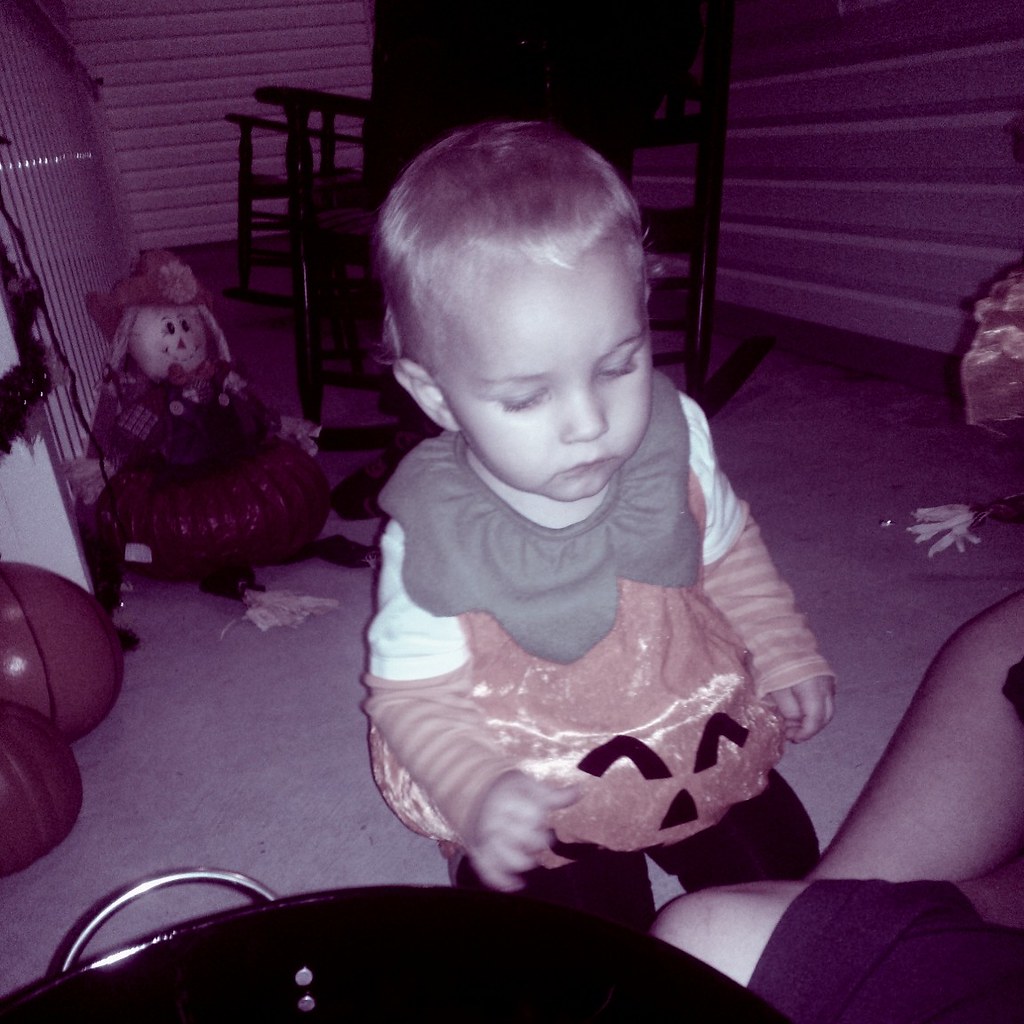
I forced myself, though ill, to take Scoot out trick-or-treating on Wednesday.  It was worth the fatigue and backache to see him, first fascinated with the glowing jack-o-lanterns, then wandering onto people's porches and trying to open the front doors, and at last getting the idea and holding his pumpkin bucket out for candy, even grabbing himself an extra piece when offered.

(Sorry this is the only picture I have available right now.  It's awful, but I know even bad baby pictures are better at luring readers than no baby pictures.)

InstaCam_2012-11-03_10-06-32-AM

Of course, everybody thought he was a girl.  He's so pretty!

-- 2 --


Halloween is also the anniversary of Martin Luther's 95 Theses.

History somehow makes out like he was bravely defying the status quo and seldom mentions that he posted them--not on the door of a church--but on something like a community flyer board, and that he was posting them as talking points for discussion.  Later, when everyone ignored him, he got angry, and started to attack the teachings of the Church, rather than just the corrupt practices (which he was totally justified in critiquing, let me be the first to say).

Then he went AWOL and started to throw out whole books of the Bible (Hebrews, James, Revelations . . .) and even tried to edit some of the biggies.

He also added the single most troublesome word in all of biblical-Christian history: the word "alone" in the "man is justified by faith alone" passage (Romans 3:28), thus beginning the single greatest schism in Christendom since Pentecost.  There's now something like 20,000 verifiable Protestant denominations claiming to be the Biblical authority.

Now, I'm writing all this from memory, no matter how well-informed that memory may be.  So please, if I've made an factual errors, correct me.

I ought to do some solid research to reference these little-known facts and write a more extensive post on them later.  Does anyone know a good scholarly book or article on the subject?

-- 3 --


My short story submission for the Tuscany Prize in Catholic Fiction has made it to the final round.

Five hundred dollars would be nice, but more than that, I need a sign from God to lift my spirits.  That's the real reason I have the gall to ask for prayers that my story would win.

-- 4 --


InstaCam_2012-11-01_12-36-04-PM
InstaCam_2012-11-01_12-42-11-PM

-- 5 --


Most recent soup concoction: roasted carrot and parsnip.  I.  Am.  In.  Love.

Just cut up some carrots, parsnips, and onions; roast in salt, pepper, and olive oil; then puree in a blender and stir in a big pot.  I cannot tell you how good it is.  And quite easy.  Here's the recipe.

-- 6 --


As Thanksgiving approaches, here's something for my "fellow" women:

homage to my hips  
by Lucille Clifton 
these hips are big hips
they need space to
move around in.
they don't fit into little
petty places.  these hips
are free hips.
they don't like to be held back.
these hips have never been enslaved,
they go where they want to go
they do what they want to do.
these hips are mighty hips.
these hips are magic hips.
i have known them
to put a spell on a man and
spin him like a top!

-- 7 --


So I really want a spinning wheel.

And no, this isn't like the time I wanted a pipe, just to carry around and suck on sans-tobacco every now and then because somewhere, somehow, deep down inside, no matter how much anyone reasoned with me, I thought it would be super-cool and fun to be like Gandalf.

"By the Spinning Wheel," Joseph-Athanase Aufray
This is a for-serious-I-must-own-one-someday.  Especially as I found out that my friend Josh owns two, and a recent picture that showed up on my friend Jenna's blog reveals what suspiciously looks to be the wheel part of a spinning wheel.

Oh, and have you noticed, my fairy tale blog is spinning-themed?  Just sayin'.

I've actually contacted the local spinning guild by e-mail twice this past summer.  No response.  I suppose I should, you know, focus on finishing to crochet the baby blanket I started to make while I was pregnant before I even think about making my own yarn.

Sigh.  Toddlers do not lend themselves well to keeping balls of yarn un-tangled.

Though, let's be honest here, I view even an unused spinning wheel as the opposite of a frivolous buy.

sig