Showing posts with label art. Show all posts

Simple Is Beautiful

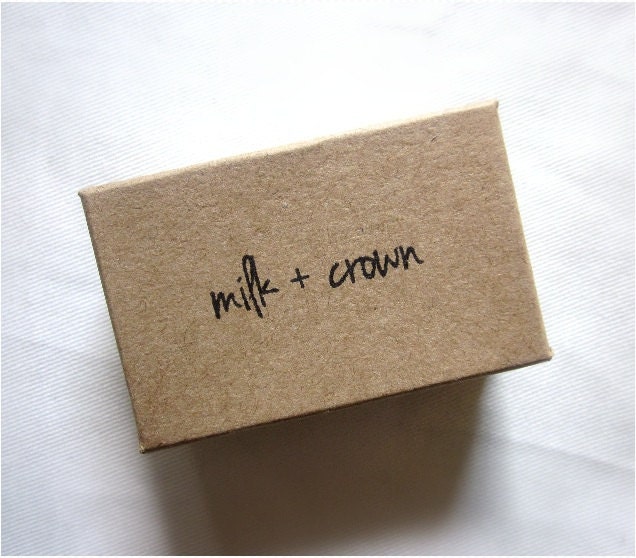
That's what stands out to me when I admire the lovingly made, 14k gold-filled jewelry at milk + crown.


Just look at the symmetry and muted light of the emma necklace or the eye-drawing and elegant tangle of the little gold ball on bryony (a name meaning prickly vines--get it?).

Also, as an enthusiastic jewelry browser (I can spend twenty minutes alone examining one section of the jewelry counter in Sears), I can assure you that these pieces are very affordable!

I believe in small businesses, using the talent God gives to support oneself and make others happy, and the good, hard work of human hands.  I'm impressed with the craftsmanship and vision that goes into these unique pieces of jewelry.  I've enjoyed getting to know Kristyn, a fellow Floridian and lover of literature, and am so pleased to be able to offer support to her budding business in any way I can.  So keep milk + crown in mind if you want to give a unique, quality gift or deserve to treat yourself; favorite, share on Facebook, and tell your friends!


Disclaimer: I receive no monetary reimbursement for the recommendation of these products.

Photo copyright Kristyn Pankiw.

sig

Five Favorites (vol. 20)


(1) Gilbert Magazine, (2) Dappled Things, (3) StAR, (4) oh comely, (5) Soul Gardening


This week I want to share my five favorite traditional publications.  The digital word is convenient and nice for bridging gaps of geography to bring people together, but I believe in black print on paper and the feeling of a cover v'd between your hands.

Most likely, I have listed the quirky British lifestyle/artsy/creative magazine as one of my favorites before, but this is a new grouping, and so I feel obliged to include it.  Also, I couldn't think of a fifth traditional publication for which I anxiously check my mailbox every day when I know that it's that time of the month/season/year!

I know I've included Soul Gardening previously.  And so what?  It stands on its own merit as a favorite outside of printed paper!

Next week, I'm going to do my five favorite online publications.


-- 1 --


Named for the infamous G.K. Chesterton, who gave this blog its name and whom I consider my spiritual teacher and father, patron saint, and favorite writer.  Gilbert is intelligent without being dense and has much to offer even those who are not fans of Chesterton.  Among its readers are multitudes of Catholics, many Christians, some Jews, and at least one Muslim (stats quoted by memory from one of the GM's past articles, so don't hold me to it--they may have changed by now).

My favorite returning articles are the editorial by Dale Ahlquist, president of the American Chesterton Society; "The Signature of Man," a column that is a re-print of some commentary of GK's on art of his day, which is, as in all of his writing, eerily appropriate to modern times; and "News with Views," little snippets of real news events that highlight the absurdity of modern culture--chances are, you won't find reports on these sometimes-outrageous-sometimes-astounding happenings anywhere else, unless you are deliberately looking for them.

Gilbert Magazine is about 1/3 Chestertonian learning, 1/3 cultural and literary reflection and discussion, and 1/3 innocent fun--if for nothing else, pick up a copy of one for its delightful illustrations!


-- 2 --


This pristine periodical is the Catholic literary magazine in English which, if it had appeared in her day, would have certainly made Flannery O'Connor cry with joy.  Dappled Things' standards are impeccable and never have I seen it to sacrifice quality art for religious sentimentalism.  Its genres are fiction, essays, and poetry, spanning the rigid but triumphant traditional forms to the languid modernity of free verse.  Every university and seminary needs a subscription.


--3--


Saint Austen Review takes a scholarly eye to Catholic culture with regard to art and literature.  It's like if Gilbert and Dappled Things got married and had a baby, and StAR was it.  Love this one!  As in DT, don't expect fluff and ginger, nicey-nice treatment.  They mean to keep Catholic art art and judge accordingly; as O'Connor said,

. . . the chief difference between a novelist who is an orthodox Christian and the novelist who is merely a naturalist is that the Christian novelist lives in a larger universe.  He believes that the natural world contains the supernatural.  And this doesn’t mean that his obligation to portray the natural is less; it means it is greater.

--4--


From made-up covers of penny dreadful novels to an interview with the roller derby queen of England, sometimes the frivolous can be good for the soul; I mean, delighting in the daily things--in mismatched buttons, scribbling self-portraits, and making your own pasta-- is far less shallow than what we find in fashion mags and gossip columns.  oh comely is that kind of read.

Oh and the tagline: "Keep your curiosity sacred."

!!!  <3

The sparse and lovely photographs aren't bad either.  c;


--5--


I can't say enough how much of a delight this little magazine is to me!  In some ways, I'm too artsy and flower-child for a devout Catholic crowd; in others, I'm too dogmatic and orthodox for a the poet-types (which accounts for the somewhat schizophrenic nature of this blog).  Soul Gardening is a perfect marriage of both.  With little reflections and tips and rhymes that bring together Catholic mothers who value classical education, the natural world, and the importance of beauty, with icon-like, folksy black-and-white illustrations, this one needs to find its way into the hands of every Catholic woman looking for a way to add dimension and quiet communion to the daily drudge.  Thank you Mary, Ursula, Sia, and Ellie!

It's also completely free.


So what are you favorite printed publications?  First Things get your philosophy and politics ticking?  Simple Things magazine lift you up with its light-as-air advice and content?  I'm always looking for great new reads.


sig

Seven Quick Takes: Volume 22

Tuscany Press Edition & Giveaway


Linking up with Conversion Diary for this week's 7 Quick Takes Friday.


-- 1 --


Tuscany Press is accepting manuscripts for the 2013 Tuscany Prize for Catholic Fiction.  Genres include novels, novellas, short stories,and young adult novels.  If you've got a manuscript lying around, or one that needs just a bit more polish, send it on over.  If they like your work, they might offer you a publication contract aside from the Tuscany Prize.  So even if it's not 100% ready for submission, you might be letting the right people know that you have a skill and to expect more from you in the future.

-- 2 --


They've recently put up an author's page so you can get to know the people behind the award-winning fiction.  We range from all over the country (and out!) and vary in race, gender, age, and ethnicity; but the one thing we have in common is a Catholic vision of art and literature.  Some of them have links to blogs and such, so you can even get in contact.

-- 3 --


And here's a comprehensive essay addressing what is Catholic fiction?  We may be inclined to think Catholic fiction requires convents and rosaries, or indiscreet moral stands such as the writings of Michael O'Brien and Regina Doman (both good authors), but the category is actually much wider.

-- 4 --


The founders are looking for ways to promote Tuscany Press and her sister projects CatholicFiction.net and CatholicInk.com, so if you work with or for a university, library, Catholic parish, or other organization that you think would benefit from an event with Tuscany Press, get in contact.  Or you can let me know, and I can contact them for you.

-- 5 --


Tuscany Press has ties with the prestigious Catholic literary magazine Dappled Things.  Some of the authors for Tuscany have also published in Dappled Things, and the editor of Tuscany Press, Joe O'Brian, is active with DP as well.  So this is a strong and growing Catholic sub-culture, with truth and beauty as its aim, but not at the expense of art.  See Pope John Paul II's Letter to Artists.

-- 6 --


Tuscany Press is currently looking for a freelance Fiction Substantive/Line Editor.  Requirements include:


1.) Experience with Book publishing  
2.) Experience with Substantive/line editing
a.) analyze the manuscript 
b.) Work in the manuscript 
c.) Address issues:
i.) Story Arc 
ii.) Character Development
iii.) Chaptering and pacing 
iv.) Transitions 
v.) Fictional Dream Issues 
vi.) Beginning, Middle and end 
3.) Knowledge of John Gardner and the Fictional Dream – also The Art of Fiction 
4.) Know of Flannery O’Connor and Mystery and Manners


Do you know of anyone who needs work or is interested?  I assume at this stage that they're going to prefer a practicing Catholic, but I don't actually know.

-- 7 --


I'm giving away my copy of 2012 Tuscany Prize for Catholic Fiction: Collected Short Stories.  Want to be eligible?  Here's what you have to do:


  • comment on this post saying that you'd like to be included for the random drawing
  • in the following week, write a brief post or paragraph advertising Tuscany Press on your blog/Twitter/Facebook/internet platform to help support its mission and get the word out


That's it!  I'll sign and address the book however and to whomever you want!  Okay?  Okay!  Thanks so much ahead of time for participating.

sig

3 Reasons I Love Catholicism

Linking up with California to Korea for 3 Reasons I Love Catholicism Vol. III.


1.  Literature


The Catholic world has turned out the most and the most quality literature, fiction and non-fiction, poetry and prose, since its founding.  Chances are, if you pick up a classic novel post-Jesus, it was written by a Catholic.  The Reformation throws the balance somewhat, but even then, the traditions from which so many of the Protestant authors draw is steeped in Catholic Tradition.  Even those pieces that are far from Christian in their aims are Catholic in their themes: they deal with questions of existence, the ugliness of original sin, true love, forgiveness, joy and sorrow, sacrifice.  Things that the Church embraces in her exquisite maternal embrace of all things human.  I mean, how honored are the lowly, that God would take on our menial existences and make them the center of truth and beauty in the Incarnation?

Shameless plug.


2.  Art


Everything said above.  Word for word.


3.  Education


You know that little ol' institution called the university?  Built by Catholics for Catholics, refined by Catholics,  higher education in the west is what it is today because of the Catholic Church.  Not going to bother citing this, as I assume it's common knowledge.  And if you didn't know that, it's as easy as looking it up in a library.  (The modern library--also a Catholic credited institution.  Thank you monks of the Dark Ages!)

sig

Theme Thursday: Bodies


f/1.8, ISO 1600

Theme Thursday link-up time at Clan Donaldson!  I don't have a lot of bodies laying around (hey, I'm not Bluebeard!), and I didn't find myself in a crowded enough place to snap photos of strangers and go without notice, so I improvised.  I like my anonymous little Venetian men in their oh-so-obviously operatic getup.

I restocked on some art supplies today, which got me looking through some old drawings, and I enjoyed looking at these sketches from the classics.  Also from Venice:


Also bodies.

That was in 2005 (I think?), but I don't think I've improved much since then.  There are huge faults in my foundational art skills.  It would be nice to take an art class for fun and to get some professional instruction.  But this not-so-new idea for dallying may just be an unfortunate side effect of the creative void left since leaving off writing a few months back.  I'll work my way back around to it eventually.  This is how I operate, in cycles, like the fickle moon.

Although, be warned: I dug out my Bamboo Wacom tablet and stylus, so this mood may be here to stay.

sig

GKC and Me

I guess you could call me a Chestertonian.  One of my most prized possessions is the (so far) Complete Works of G.K. Chesterton published by Ignatius.  I was a regular subscriber to Gilbert Magazine before finances got tight.  So much of my thought on faith and fairy tales is informed by Chesterton's childlike wonder, intelligence, and simplicity.  I'm a bit of a Chesterton quote spammer.


This post is about GKC and me; how I learned of him; what book of his I first picked up; what about his life, writing, and philosophy resonated with me; how I've come to call him a my patron saint and spiritual father.  This post was inevitable, but a few expressed reservations from kindred spirits makes the time ripe for an introduction.

Before we go any further, the caveats:

1.  Chesterton is a polemicist.  He's not an apologist of the breed of Dinesh D'Souza, C.S. Lewis, and Scott Hahn.  He's certainly not a theologian like Saint Thomas Aquinas or Peter Kreeft.  He's a debater, both verbal and literary; and debate is a unique school.  It requires pithiness; it assumes an ideal listener/reader, and includes an appeal to pathos as well as logos.  There are certain truths, whether timeless or circumstantial, that must be kept in mind when reading Chesterton, and often there are obscure references to current events that would not have been at all obscure at the time of publication.

Chesterton is timeless in the sense that our repeated failures are timeless.  Otherwise, he is very much a man of his time and culture.  That's very important to keep in mind when reading any author, but even more so with GKC because a lot of what he says assumes pre-established facts.  As a debater, he just wouldn't have had time to go into them, and rightly leaves those metaphysical arguments to the experts.  His one-liners are almost never meant to be taken super-literally and, out of context, can appear downright absurd.

2.  Chesterton is not antisemitic.  This ridiculous and unfounded rumor has been proliferated and preserved by figures as weighty as T.S. Eliot.  The slander of antisemitism is lifted from quotes taken out of context, a modern day backwards application of political correctness, and super sensitivity that sacrifices necessary honest but respectful dialogue for "not hurting anyone's feelings."  Gilbert Magazine devoted a whole issue to address this claim, which can be downloaded for free.  There's no longer an excuse to accept the malicious accusation.

I hope that wasn't too unpleasant.

I consider Lewis, Tolkien, and Chesterton to be My Big 3.  My love for Tolkien led me to Lewis.  My love for Lewis led me to Chesterton.  Each one shaped who I am today, each person tapped into a part of my personality and soul and nourished it; and, if all did it using different techniques and strengths  from different perspectives and at different angles, that part of me that they shaped is the same and oriented toward the same ultimate good.

Toward the end of my first year of college, I had devoured 19 books by C.S. Lewis, a staggering accomplishment for the world's slowest-reading bibliophile.  Still I wanted more.  Much like I did with Tolkien when I "discovered" Lewis, I frequented articles and forums online, gleaned little bits of information and anecdotes.  I had read Surprised by Joy, of course, and once again saw the name Chesterton popping up with reference to Lewis.  Somehow, I ascertained that this guy was a Catholic.  Naturally, my interest piqued.

I read Orthodoxy and was not disappointed.  Now I'll attempt to describe something that is very hard to communicate in prose.  It's more naturally expressed by art and poetry.


A sentence of Chesterton's is a microcosm of any book; a book, of his entire body of work.  When I read Chesterton, his sentences slapped me in the face, like getting a cold shock of water first thing in the morning.  They literally struck me as truth.  This isn't because his thought is so original that I'd never heard of it before and was astounded to realize him right about it.  Rather, he presents what-is in clarity, distilled in purity, like snow melted mountain water.  Here was a man who unlocked all the tightly raveled God-knowledge of my nascent soul and presented it to me: not as a bride, like Tolkien, in beauty and mystery; not as a mother, like Lewis had, in comforting familiarity and profound love and awe and devotion; but as my own child, an impish joyful thing, astoundingly complete in itself, innocent yet immortal, infinitely familiar to me, utterly surprising and unpredictable.

So, in a parodox (of which Chesteroton is a great advocate), I was knocked off of my feet by this unflinching sense, what we call common sense; only it's not so common anymore.  Since the Fall there's been this dichotomy between good human instinct and an idolatry of human thought.  Some people reason themselves into madness; some into a sanitized, inoffensive creed (Luther, for instance, and the philosophers of the Enlightenment).  Since the Catholic Church lost her queenship in the west, sense has dwindled to a rumor, dismissed as prosaic, found altogether inconvenient.  So there's this strange effect of hearing from Chesterton something both new and familiar.

I've heard people more or less chalk up the popularity of Chesterton to bias confirmation.  And to that I would answer: yes, absolutely.  In the sense that siding with the truth, the kind of truth that can't be tested with the scientific method, is bias confirmation.  Chesterton affirms our instincts.

I can see how someone wouldn't like Chesterton.  His word-play and hyperbole is only one taste out of many.  He's easy to mistake for cocky because of his confidence, though his confidence is like that of a saint: completely unfocused on himself but rather on truth, indeed the Truth, out of pure love and devotion to it.  As he says in The Catholic Church and Conversion, "It is not bigotry to be certain we are right; but it is bigotry to be unable to imagine how we might possibly have gone wrong," and he demonstrates that true humility to a T.  Still others consider him chauvinistic.  To that, I point insistently to caveat #1.  As to the rest of it, I can only say: even Tolstoy didn't like Shakespeare.  There's no accounting for taste!


One final thing.  Chesterton is also my teacher in poetry.  Although that wasn't his thing (Tolkien put his perfectionist frown on The Ballad of the White Horse), his worldview is that of the poet.  He said something profound and simple and alarmingly obvious when he said, "The aim of good prose words is to mean what they say.  The aim of good poetical words is to mean what they do not say."  He gets it.

Much of Chesterton's revelations come to him because he sees the wide world the way a poet does.  Not as something familiar and taken for granted, but as an astounding and strange thing, like a fairy tale.  Why, he asks in Orthodoxy, do we assume that because a tree grows apples that it couldn't very well have grown tigers hanging by their tails?  And what will it take for us to notice, gooseflesh and tiny hairs rising, that apples grow on trees?  That the sun rises every day, without having to be wound up?  That breathing is a miracle, and babies laugh, and wine is so, so warm and good?  How can we make ourselves smell and hear and taste, and be shocked out of complacency?

What is the job of a poet if not to bring forth those delightful shivers?  To dare to inspire a soul to prayer or a call to action?  To look at things-that-are in a way that makes us tremble with fear and wonder and walk away changed; either like the man who went away sadly when Jesus told him what he must do to obtain the Kingdom of Heaven, or like the healed one who went out and proclaimed, "I was blind, but now I see."
sig

Five Favorites (vol. 8)


It's almost 3 AM here, and someone isn't the least bit sleepy.  We had a long nap today, but still, this is insanity.  Life has been one long adventure in insomnia since The Squirt was born.  Not sleeping is his superpower.  But it's too much of a nuisance to make him a superhero.  He'd have to be a super villain.  Just call him The Insomniac.

So, Five Favorites:

1.  When in Rome art print by Rebekka Seale


About a year of fandom from me for this Nashville artist; she paints with minuscule brushes that really do the trick.  And well, yeah . . . Flannery O'Connor.  Southern Catholics are their own special breed of Awesome.

2.  Ulta nail polish in TuTu Cute


The nail polish from here.  Coming in handy now with a top coat of Sally Hansen Instadry clear nail polish.

3.  The Ink Nest


At $8 a set, you might think t's a bit pricey for four to twelve little doodle things that only exist in virtual space.  But the cost of custom clip art for a blog, stationary, or business would be much more costly.  And they're so pretty!

4.  Mrs. Meyers Clean Day cleaners in Basil


I like all Mrs. Meyers Clean Day cleaning materials because they're non-toxic and come in natural scents that smell like a dream.  Basil, though, is by far the best--even beating out lavender.  It's literally the freshest my home ever smells.  It's expensive, but a little bit goes a long way.

5.  emerald earrings


From Overstock.com.  But I really like the ones Martha found.  Did you know green, especially that almost teal-green, is my favorite color?

---

See more favorites at Hallie's.


sig

here is my secret


here is my secret
it is very simple
one sees clearly only with the heart
the essential is invisible to the eye

sig

The Holy of Ordinary

Saints and Symbols


One definition of an icon is "a sign or representation that stands for its object by virtue of a resemblance or analagy to it" (dictionary.com).

Perusing many books published on iconography, I gather it interests not a small amount of people.  Since there are only so many different stages of life, sexes, cultures, and locations in which to communicate which saint is depicted in an icon--and there are thousands upon thousands of saints-- relevant symbols tend to accompany them in pictures.

The means by which these symbols are integrated into the identity of their saints quietly humbles me.

Not so much the usual ones.  Most symbols are, by nature, easily identified.


Some are associated with profession: 


Saint Joseph, a carpenter, carries a carpenter's tools; Cosmos and Damien those of a doctor; Bernardo of Sienna looks down unmoved by the three bishop miters he rejected; Saint Louis of France wears a crown (hint: he's a king).

Saint Louis of France

Others are identified by means of death or torture: 


Peter of Verona, one of the most interesting, wears a cleaver lodged into his skull, like some tacky, twentieth-century Halloween costume.  Then there's Saint Denis, a living body holding his decapitated head in hand.

Catherine has her wheel, Lucy her eyes, Agatha her breasts.

The mortal mind easily views the parallels.

But sometimes, the connection between the saint and symbol are peripheral.


There are animals and animal companions:  


Vitus has a rooster, which was thrown into a pot of boiling oil with him; Agnes gets a lamb because, well, her name looks and sounds like agnus (lamb in Latin);  Saint Giles protected a deer, and  Bernard has a white dog, who appeared to his mother in a dream when she was pregnant with him.


And people and paraphernalia:  


Bavo of Ghent brings his hollow tree, in which lived as a hermit; Ursula herds a crowd of virgins under her cloak, her fellow martyrs;  Diego of Alcala carries the flowers found in his cloak when a friar confronted him, suspecting him of stealing food to give to the poor.

Saint Cecilia

The music of Cecelia's wedding celebration is always with her in the form of an instrument.  Barbara holds her tower of imprisonment and later hermitage.  Nicholas, three golden balls, which he gives as dowry to rescue three girls from prostitution.

These are the ones that give me pause.  

For such random objects and things to become the sacred symbols of the those in Paradise hints at a profound insight into the nature of our God.  The saint, who loves Him and aspires to Him with all his being, engulfs everything he knows and sees into that first and reckless Love.  And the ordinary, by virtue of touching a holy life, is drawn up into the beatific vision.


Picture Book Spotlight


I found this delightful book at my local library.  Mama Says: A Book of Love for Mothers and Sons sold me right away when I saw it was illustrated by Leo and Diane Dillon.  But opening it up affirmed my decision to bring it home to share with my little one.

Each two-page spread depicts a mother-son pair from various cultures, with poetry in both English and their mother tongue.  The creators took special pains to obtain accurate translations.

You can see the Japanese to the right of the original English.


Touching lessons from mother to child resonate with timeless wisdom:

Mama says
Be good
Mama says
Be kind
Mama says
The Rain will come
But still the sun will shine

And

Mama says
Have faith
Mama says
Believe
Mama says
To trust in God
And let God take the lead

I have to encourage mamas, especially mamas of sons, to consider adding this beautifully illustrated book to their collections.

Remember: our children are immortals.  Strive to raise saints!


The Art of Fairy Tales

It goes without saying that my favorite artists from childhood are depictors of fairy tales.  Anyone that knows me well knows I adore fairy tales.
The Twelve Dancing Princesses by Sheilah Beckett
But they are often overlooked and undervalued as "just stories."  We forget the intrinsic value--as well as their convenient use as teaching mechanisms for truth, beauty, and the imagination--that fairy tales have to offer children.  And yes, even adults.   

Especially adults.

As Chesterton said,

"I left fairy tales lying on the floor of the nursery, and I have not found any books so sensible since."


Me too, Gilbert.  Me too.

I will have to devote an entire series to fairy stories, at some point, but that is another task for another day.

Not my personal book, but it could be!
For now I want to share these classic and beloved artists I encountered in the books of my early youth; they made such an impression, I have not ever forgot them.  And when I picked up an envelope for alms at Easter Sunday mass, an elegant and colorful little square illustration caught my attention.  The envelopes were decorated with individual portraits of different saints, and though I had never seen them before, I recognized them like bygone playmates.

I went home and dug up this book, The Twelve Days of Christmas, illustrated by Sheilah Beckett.  I have been unsuccessful in tracking an illustrated book of saints by her, but the search continues.

Meanwhile, allow me to share these tales with you. I encourage you to add them to your own library, whether or not you have children of your own.

Sheilah Beckett


Born in 1913 in Vancouver, Ms. Beckett never attended art school.  She has illustrated many children's books, including the Little Golden Book I saw in the grocery store and begged my mother to buy me.

Her caricatured figures and whimsical animals preceded Walt Disney's major motion picture Snow White.  The detail of period costumes is delightful, and my favorite?  The flowing nouveau-esque hair!

The Gift of the Magi

Lisbeth Zwerger


A couple I once stayed with in England collected children's books illustrated by Lisbeth Zwerger.  The Legend of Rosepetal enchanted me immediately.  She was born in Vienna in 1954 and is an award-winning illustrator.

The only book of hers I have been able to purchase in a bookstore is The Gift of the Magi.  In this book in particular, I admire the sketchy, messy layers of lines that highlight flow and movement.

The Lion, the Witch, and the Wardrobe

Leo and Diane Dillon


This husband and wife team won two consecutive Caldecott Medals for their children's books.  They are well known for their re-telling of African folk stories.

I encountered the pair in a small bookstore when I brought home a used copy of The Race of the Golden Apples.  It is still one of my treasured books with its fusion of smooth color and flat textures.  Their graceful depiction of the human face, in particular, has influenced my attempts at realistic drawing.

- - -

For further reading on fairy tales and their place in the baptized imagination, see J.R.R. Tolkien's essay "On Fairy Stories."