May 1, Feast of St. Joseph the Worker, St. Walpurga, May Day, and Mary's Day.
Last evening, we celebrated St. Walpurgis's Eve with a romp on the beach. Afon ran straight for the cold waves, shoes, socks, trousers, and all. I had to run in after him (shoes, socks, trousers and all) but he was not dismayed. Until later, when he realized how uncomfortable it was to be wet, even on a mild evening in spring.
When the tide is out, the rocks are things of beauty, and for all the white-sugar sand of the Gulf coast of Florida, it doesn't touch the raw, remote, mineral beauty of the Irish sea. Pebbles are worn smooth and creamy from the patient centuries. It's a hard kind of thing to capture with a camera, so I'm glad I left it behind this once and enjoyed being in it. The beauty of the Welsh seashore is a dimensional thing; it's in the atmosphere, a haziness that color and line and form can't quite capture. The mussels sprout like so many blossoms on the jagged rocks.
I've always counted the seasons of Wales in flowers. The sign of winter's waning is marked by the coming of the snowdrops. We arrived in March, just in time for the daffodils. They're season fades for the time of the bluebells, and they are even more numerous than Saint David's flower. Soon the hydrangeas will harken the summer.
But there are many, many flowers here, the apple blossoms, tulips, dogwood, and primroses. I think this is a Kazan Flowering Cherry. They appear in lush poms and snow torrents of true-pink petals. The trees are here and there in Colwyn Bay, but this one is at the entrance to Tan-Y-Coed gardens along the Old Colwyn river.
I've gained a sizable collection of little makeup tips and tricks over the years and come back every now and again to the idea of publishing them here, to keep a record for myself and to pass the knowledge along to others. As I got down to writing, however, it became apparent that I would first need to set out a philosophy of makeup, at least for me personally, because makeup-wearing covers a great expanse of tastes and purposes. It's also highly personal and subjective. Like in art and parenting, learning the rules is just the first step toward breaking them. There is no one right way to wear makeup.
So here is a little breakdown of where I'm coming from when I recommend or write about makeup on this blog. (It can also apply to fashion.)
One of the most flattering comments I ever received was from a friend who said she liked how I wore makeup. I can't remember her wording exactly, but the gist of it was that she saw how it improved my appearance, and it didn't look like I wasn't wearing any makeup, but it didn't look like my makeup was hiding me either. I liked that a lot because it is exactly my makeup philosophy.
Makeup serves two main purposes: (1) to decorate and (2) to beautify. These purposes don't have to be mutually exclusive, but I think when the decorating takes away from, distracts, or frustrates one's God-given beauty, it's a shame. Except in the case of costuming, such as during Halloween or a stage production or festival, my rule of thumb is to use makeup to decorate in a beauty-enhancingway. I think some women who are afraid of wearing makeup have been scared away by the misuse of decorating-type makeup.
Let us illustrate the two purposes with the following:
In the first photo, the eyeliner is soft and smudgy. If you were to take several steps back, so you weren't, you know, staring this poor stranger in the eyes at an uncomfortably close distance, then the definition of the makeup marks would become less and less clear, 'til it blended in with her lashes, making them look thick, full, and numerous--traits commonly considered attractive in the human female. In the second photo, if you were to step back, the definition of the eyeliner would remain clear for a much greater distance; the line is solidly defined, and the colors and luster are not naturally found on the human face. See the difference?
There are all sorts of variations on these two styles above, and as many variations for each part of the face, and even for each makeup product. I have both purposes for wearing makeup; my daily routine aims to beautify, but every now and again I like a smudge of red lipstick or colorful eye-shadow.
What is your makeup philosophy? Do you wear makeup, and why or why not? What is your main purpose in wearing makeup?
(Also, if you're interested, there's some thoughtful Lenten discussions on modesty going on here.)
Let's be honest here: I don't make nail polishing a regular thing, but I'm starting to think I ought to. Even the name suggests a sort of tying-up and patting-down, the finishing touch of a well-put-together woman ("She's so polished, right down to her nails!"). I like the idea of old Hollywood glamour, making a certain amount of ceremony part the everyday. My father's raised me on the black-and-white dramas of Greta Garbo and later Katherine Hepburn, who wore trousers with a bored look that said, "Why yes, I do ride." Back then, the average woman might have a use for an evening gown without having to enter a beauty pageant. You had to think about it before going somewhere. It took planning. You couldn't just dash out the door. Not if you had to pin on a hat. And how elegant would it be to cast your gloves down on the hall table when you come home?
All dreaming aside, I thought my polishing days were over after I had a baby. But lo-and-behold, there is this awesome phenomenon (#2) that makes painting nails not too much more than an extra step in your bedtime routine. After applying the nail color of your choice, you wait a one minute before applying the Kwik Dry clear coat. After that, it dries within minutes. So much more practical than sitting in a salon. Like anyone has time (or money) for that!
The other polishes in my "collection" are ones I've had from years ago (told you I don't wear it often!) or that I've found at Big Lots for a dollar. The only one pictured above which I don't actually own is #4. Anyway, I like that they're subtlety spring without being Easter egg-pastel.
My fashionista baby sister swears by soft pink, and it looks nice on pretty much all skin types. Just as long as you avoid matching it exactly to your skin tone; that'll just blend in and wash you out. essie's Butler Please is TARDIS blue; kinda says spring in London to me--a traditional color with a fresh brightness that's not at all shy. OPI's Green with Envy is likewise fresh, without being sweet and simpering. And gray . . . I'm really liking gray nail polish right now. It's sophisticated without aging, and I think it's a good middle way between light and dark to transition well from winter to summer. I've also got a Sinful Colors in In the Mist, which is kind of gray, kind of dusty moss.
Pair one of these colors with Christy's bright lipstick and winter will be running for cover.
Do you wear nail polish? What's your favorite brand or go-to color?
Feb. 1, Feast of St. Brigid of Ireland, the Mary of the Gael, who, among many other miracles, when she asked for land, was granted all that her cloak would cover. When she lay down the garment, it spread for miles. She was born into a high Druid family and was instrumental in the smooth transition between the the old ways and Christianity. St. Brigid is patroness of blacksmiths, boatmen, cattle, chicken farmers, children whose parents are not married, dairymaids, dairy workers, fugitives, infants, Ireland, mariners, midwives; milk maids, newborns, nuns, poets, poultry farmers, printing presses, scholars, and travelers.
The Secret of Kells by Carton Saloon
(image source)
In honor of St. Brigid's Day, I'm sharing an old post from my other (often neglected) blog, Spinning Straw into Gold. Though the holy marriage of fairy tales and the Faith is not immediately obvious, the signs are there for those who pay attention. I hope, if you like these thoughts, that you'll consider clicking over to Straw into Gold from time to time, where I happen to headquarter my third of our lively Harry Potter book club.
------
I've only recently encountered this delightful animated film from 2009. The Secret of Kells is about a boy growing up in the walled abbey in Ireland during the time of the Viking raids, while the Book of Kells was being penned and illustrated. It was an instant favorite for my family, and we play this song to our little one all the time.
This clip shows the highly stylized animation that evokes traditional Irish art. Much could be written about these exquisite and deceptively simple illustrations.
The plot is straightforwardly simple, so much so that I was a bit surprised when the credits started rolling. However, after stepping back from the experience of viewing to examine the whole, a clear theme emerged: that of the perseverance of human nature and its ability to create art in spite of trial.
The Book, not yet known as the Book of Kells, arrives in the abbey fortress with the famed illuminator Aidin, sole survivors of a Viking raid to the island of Iona. Brendan is told by his uncle Cellach to keep away from the Book, as well as the forest that creeps up to the very threshold of their settlement. Both are dangerous in different ways.
Cellach's intentions are worthy enough; day and night, he labors over the design and construction of an immense wall, intended to hold out the Vikings and defend the abbey and those who look to it for protection. But the lure of the Book's mystery speaks to young Brendan. Once he glimpses the fantastic illustrations, he longs to be a part of its making. He risks disobedience at Aidin's behest and ventures into the woods to find berries for ink. There he meets Aisling, a native faerie, who befriends him and teaches him the mysteries of the wood. As Brendan's knowledge grows in the art of illumination, so does his appreciation for the art of the natural world.
The Secret of Kells is about pushing through adversity to continue making; about the human soul reaching out for beauty, and the way art transforms, even as men and women transform the materials around them into something new, especially works of art.
In times of trial, we are tempted to point a finger at the dreamers and idealists; it is hard to see what the value of art is in a world of destruction. Beauty and utility clash. What good is a lovely song or a moving picture when death lurks at the end of every day? This is the abbot's unspoken question in Kells. Cellach, the abbot of Kells, was once an illuminator himself. Jaded by hardship and worry, he forsook it and took up the task of building a wall to protect those under his care. So desperately does he try to preserve life at any cost, he shuts out that which does not directly contribute to that aim. He banishes his sense of wonder and refuses to acknowledge beauty. One cannot eat a poem, he reasons. A painting cannot stave off death.
What Cellach believes will protect him, however, ultimately proves useless. Only, having shirked joy and the hope inherent in creating things solely for beauty's sake, he has failed to treasure the gifts and talents (and people) he had while he had them. He has neither safety, nor hope.
Fortunately, the film doesn't end on the wasted Kells and the empty abbot. Brendan, who, with a child's innocent wisdom, recognized in his own way the importance of the Book, facilitates his uncle's reconciliation with truth and beauty before the end.
It's a well-made, thoughtful movie, and I highly recommend it. Whether intentionally or not, The Secret of Kells speaks to why we should still tell stories, especially fairy tales. Our voices matter, and our efforts are not made in vain; just as the aged monk's were not, who could not have guessed the profound richness with which he endowed humanity, when he first picked up ink and quill.
Jan. 18, Feast of St. Prisca, a child martyr captured by the emperor Claudius and tortured. She glowed with light like a star, so the emperor ordered her thrown into an amphitheater with a lion. The lion licked her bare feet. In the end, Claudius had her beheaded.
It's kumquat season. These oblong citrus fruits populate a tiny area in an only slightly less tiny town. So tiny that it doesn't even have its own zip code, and its mailing address adopts the name of a nearby town. It's neat to see how identity and location is wrapped up in something so . . . little. But something quite distinct. It's not an orange, and if the orange was the primary crop of this little hamlet, it would not be what it is, but a different place altogether. As different as if the French had won the war to keep North America or electricity had never been invented. Identity, and significance, is tied up in specifics. In the being of one thing and the not being of another. The town is the town it is because kumquats are not oranges.
The biggest local event (held in the nearby town) is upon us in a week. The Kumquat Festival draws impressive crowds for our area, and the people who travel, sometimes for hours, to attend want their fill of kumquat: kumquat ice cream, kumquat soda, kumquat jam, kumquat salads, and, of course, a slice of kumquat pie. So the childcare center has been making pies like mad this past week, to sell at the festival. That means more working hours for me (good) and less time to recoup and recharge and rest (not as good).
I feel guilty that this steady, nine-to-five (technically, 8:30 to 5:30) working pace drains me so and leaves me frazzled and strained. I tend to torture myself with mental lectures about how so many people do this, and do it gratefully, and don't feel sorry for themselves. But the reality is that I'm not one of those people. For better or worse, my limits are what they are. And beating myself up about not having a larger stress capacity is useless in the the most final and unalterable way. The best I can do is to manage as best I can, and let myself be for what I'm not capable of.
So I'm looking forward to the slow-down (a week? two at most? I hope!). To getting back into rhythm, which is as nourishing as a healthful, home-cooked meal. I ordered one of Mama's Notebooks and am looking forward to using it. I'll try to remember and find time to share how I like it. I'm sure I will; it covers everything, from meal planning to spiritual growth. And if I'm not the poster child for clearly setting things out and referring back to the guidebook to accomplish the simplest of everyday tasks, I don't know what is!
I've enjoyed reading everyone's hesitant-but-hopeful aims for this year. And of course I've incubated a few of my own, even when I didn't realize I was doing so. So I might as well punch them down here. Changes and/or continuances I want to execute in 2014:
I'm anticipating being a place where I can Mass other than on Sundays. I don't feel brave enough to say daily Mass yet. If I aim for just one daily Mass and then manage (through the grace of God, always!) six, I'll feel very happy with the situation!
Join some close friends in praying daily the Divine Mercy chaplet.
Adding regular exercise back into my life. Walking briskly with Afon in stroller or else by myself when I get the chance; maybe even adding running. But that's a big maybe and will take a tall can of energy drink beforehand.
Go back to frequent grocery shopping; this will tie in with meal planning, for which I intend to utilize my new notebook of power!
Pray first thing in the morning.
Continue my self-education in cloth-making, and close the gaps in the process by familiarizing myself with all the steps, from spinning to finished crochet/knit project. Maybe, if I'm feeling up for it, learn to sew patterns with a machine.
Write daily.
Attempt a daily schedule. Something like: prayer, exercise, dress, breakfast, Mass, writing period, lunch, grocery shopping, park time/play time/play group with my son, dinner, leisure for internet, crochet, reading, etc. (As I type this out, I find it very intimidating!)
Five first Saturdays--will this be the year for a plenary indulgence? I hope so!
It's a bit overwhelming, but I draw armfuls of comfort from this little online blogging community, and the prayers I know that get irretrievably tangled with each complex and overlapping electronic relationship, and the graces cast down from heaven as a result. Thanks for your friendship. Thanks for being a presence on the internet for hurting, weary women to find the Body of Christ. Thanks for writing your blogs, and updating them, and remembering them again after a half a year. Thank you for reading mine.
Dec. 18, Wednesday of the 3rd Week of Advent, Day Three of the Christmas Novena.
f/1.8 // ISO ??? // ???
Can you totally tell this is tampered with in Picmonkey to make it look like snow?
I'm dreaming of a white Christmas.
As I write this late(ish) on Wednesday night, sleepless and uncomfortable from yet another virus, I'm predicting that the popular Christmas song (and movie! twice!) is Cari's inspiration for this week's Theme Thursday. Sadly, there will be no snow for us this Christmas, lest glacial melting and global warming take vengeance and usher on the Apocalypse . . . and that's just no fun and not what I had in mind for Jesus's coming, even the second one.
But I do dream of white Christmases, and dreaming is memory--at least, they must come from the same place in the soul. And even though I now live in a sub-tropic clime, I'm a child of Midwestern winters, and the hard, warm snow that fell on flat, dry grass, lending its porcelain silence to a drab and weary backdrop.
I remember waking in the dark of early morning, breath held. Even if no word came from the television that school was canceled due to snow-blocked roads, I still thrilled to step out into the white-and-black world. Snow makes stars sharper, somehow. I'd bundle up and go out early to wait on the corner of the street. My feet were the first imprint; it was surreal, like crossing finest sand on a beach no human soul had touched on another planet. Everything was suddenly closer, the world made smaller; you know, sharper, like when you twist your camera lens and everything comes into focus, so that you can see each tiny grain of glass. As if the light reflected drew the sky down to gaze at her own reflection. I stood there for ten, fifteen--twenty minutes well before I had to; before the other children--noisy, shoving and joking, oblivious--came out to wait with me; before the squat bus lumbered over the road toward us, and broke my shimmering bubble of infinite yet self-contained existence.
I mean, there's more than one reason it's called a snowglobe.
Dec. 10, Feast of Pope St. Miltiades (Melchiades). Tuesday of the Second Week of Advent.
I grew up acquainted with Santa Claus. Christmas Eve was better by far than even Christmas Day because the expectation and the ideal of the luxurious presents in colorful disarray beneath evergreen boughs was by far better than the reality--though that was pretty good, too! And what could have incarnated and represented this sweet expectation better than Santa Claus? That mysterious resident of Faerie, good-natured but not permissive, who defied all science (though not the logic of the human heart) and visited every single house in the world in one breathless night, bestowing gifts to good children in homage to the Christ Child?
I knew Santa was sometimes called Saint Nick, but I learned of the historical saint much later. As I fell deeper in love with the Faith, I was tickled and proud that our own dear bishop should be the source and inspiration for my beloved childhood friend. Interest in foreign cultures and anthropology introduced me to many delightful traditions regarding Nicholas and Christmas--including the medieval liturgical celebration of his feast on December 6th, still observed in some European countries.
Meanwhile, Father Christmas, understood to be more or less Santa Claus's British counterpart, endeared me to him in the sacred stories of my adolescence. To this day, the phrase "always winter, never Christmas" gives me delicious chills, causes me to crave Turkish delight, and attracts me to wardrobes.
Now my own son is coming of age, that holy age of unbridled imagination.
Last year, Father Christmas left him candy and presents in an over-sized stocking; last week, Saint Nicholas tucked sugared oranges and miniature candy canes into his little shoes. I want to submerge him in the alternative lifestyle that is the Church calendar and teach him the mysteries of human story; for for me, the realm of Faerie and the Truth of the Faith are not mutually exclusive. On the contrary, I don't believe I could even approach one without the other.
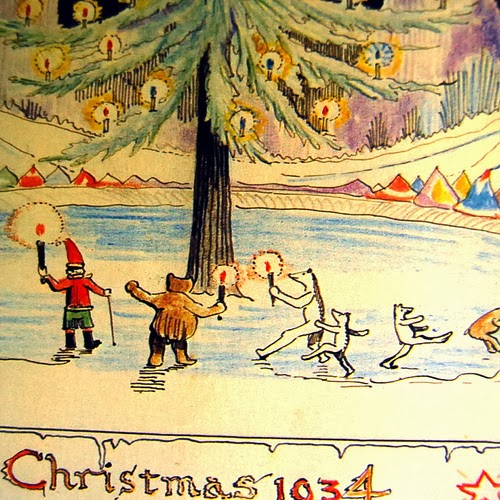
an illustration of Father Christmas at the North Pole by JRR Tolkien
Many people think that Santa Claus is St. Nicholas "in disguise." Actually the two figures have nothing in common except the name.
That threw a wrench in my dewy-eyed, fanciful plans for integrating the magic of my childhood with the magic of the Incarnation. If Santa Claus is merely a sanitized, Protestant-scrubbed, secular shell of the real Saint Nicholas, how can I justify continuing the tradition that weakens the life-giving and salvific richness of the Catholic Faith? Yet I wouldn't deprive my own son of that poignant joy of Christmas that nurtured my imagination and cultivated my soul in preparation for greater mysteries. Who, indeed, says it better than Chesterton:
What has happened to me has been the very reverse of what appears to be the experience of most of my friends. Instead of dwindling to a point, Santa Claus has grown larger and larger in my life until he fills almost the whole of it. It happened in this way. As a child I was faced with a phenomenon requiring explanation. I hung up at the end of my bed an empty stocking, which in the morning became a full stocking. I had done nothing to produce the things that filled it. I had not worked for them, or made them or helped to make them. I had not even been good–far from it. And the explanation was that a certain being whom people called Santa Claus was benevolently disposed toward me. . . . What we believed was that a certain benevolent agency did give us those toys for nothing. And, as I say, I believe it still. I have merely extended the idea. Then I only wondered who put the toys in the stocking; now I wonder who put the stocking by the bed, and the bed in the room, and the room in the house, and the house on the planet, and the great planet in the void. Once I only thanked Santa Claus for a few dolls and crackers, now, I thank him for stars and street faces and wine and the great sea. Once I thought it delightful and astonishing to find a present so big that it only went halfway into the stocking. Now I am delighted and astonished every morning to find a present so big that it takes two stockings to hold it, and then leaves a great deal outside; it is the large and preposterous present of myself, as to the origin of which I can offer no suggestion except that Santa Claus gave it to me in a fit of peculiarly fantastic goodwill.
I think Chesterton would also agree that what the article on Catholic Culture finds distasteful is that which makes Santa endearing and recognizable in a profound way.
Behind the name Santa Claus no longer stands the traditional figure of St. Nicholas but the pagan Germanic god Thor (after whom Thursday is named). To show the origin of the modern Santa Claus tale let us give some details about the god Thor from ancient Germanic mythology.
Thor was the god of the peasants and the common people. He was represented as an elderly man, jovial and friendly, of heavy build, with a long white beard. His element was the fire, his color red. The rumble and roar of thunder were said to be caused by the rolling of his chariot, for he alone among the gods never rode on horseback but drove in a chariot drawn by two white goats (called Cracker and Gnasher). He was fighting the giants of ice and snow, and thus became the Yule-god. He was said to live in the "Northland" where he had his palace among icebergs. By our pagan forefathers he was considered as the cheerful and friendly god, never harming the humans but rather helping and protecting them. The fireplace in every home was especially sacred to him, and he was said to come down through the chimney into his element, the fire. (See H. A. Guerber, Myths of Northern Lands, vol. I, p. 61 ff., New York, 1895).
Here, then, is the true origin of our "Santa Claus." It certainly was a stroke of genius that produced such a charming and attractive figure for our children from the withered pages of pagan mythology. With the Christian saint, however, whose name he still bears, this Santa Claus has really nothing to do. To be historically correct we would rather have to call him "Father Thor" or some such name.
The article dismisses the modern American Santa Claus as drawing his identity from "the withered pages of pagan mythology," which, I must admit, stupefies me. Are we talking about the same powerful mythic tradition that taught Tolkien to glorify God Almighty in Middle Earth; that gave C.S. Lewis cause to pause and consider the existence of Truth and the Fall in the soul-shattering phrase, Baldur the beautiful is dead, is dead--?
But surely if Santa Claus has his origins in Thor, he can be found earlier than the 1800's poem and capitalist propaganda. What about Father Christmas? He has a totally different name. Could he have been adapted from Santa Claus, or Santa's predecessor, Saint Nicholas? And who was that guy in Dickens who appeared with long beard in laurels and robes, with rosy cheeks, calling himself the Ghost (read "spirit") of Christmas Present?
the Ghost of Christmas Present in Charles Dickens's A Christmas Carol
References to a spirit of Christmas go back to the early renaissance. Ben Johnson has a character appear in a masque reminiscent of medieval mystery plays, in which abstract ideas and attitudes were personified. He wasn't a giver of gifts--that element belongs to Saint Nick--but a merry-making lord of sorts, a mysterious emissary from an Otherworld that occasionally overlaps with our own during a liminal time (an acceptable time)**, the threshold of winter. In this guise, he is reminiscent of an enchanted Bertilak in Sir Gawain and the Greene Knight*--which would put his origins back even further, overlapping him with the likes of the Green Man, who is interpreted to be a symbol of the cycling back of life to rebirth in spring. And what a fitting role for Father Christmas, who heralds the crowning glory of Advent--Advent meaning "coming," and a sometimes synonym for "beginning." What is the coming of Christ if not the new beginning?
What I found is that the article was right, after a fashion. Santa Claus, e.g. Father Christmas, and Saint Nicholas are not the same. Nor does either benefit from the mistaken identity of Macy's famous fat man. Each is significant, and each has his role to play in Christendom. Before Advent of this year, I had a sketchy but certain idea that Saint Claus would be our family tradition. Now I feel differently.
Both are important to the kind of formation in Faith I want for my son: Saint Nicholas, the friend in Heaven and model of Christian charity and steadfastness; Father Christmas, the amalgamation of that most accurately and truly expressed in a benevolent and sometimes dangerous man who, like nature, God's own creation, points to mysteries beyond himself and a reality not yet fully grasped.
We'll have both visitors in my home this year--and, I hope, many, many years to come. Now all I have to do is figure out the Easter Bunny.
* Also, Harry Potter's Hagrid, anybody? ** Kairos tou poiesai to Kyrio. "It is time for the Lord to act." When time touches eternity; eternity reaches down into and pierces time.
Oct. 17, Feast of St. Ignatius of Antioch, bishop and martyr; patron of the Church in the eastern Mediterranean, the Church in North Africa, and throat diseases.
Generally, I only like pure orange in the context of autumn. As a winter, spring, or summer color, it's brazen and hot, obnoxious and reminiscent of the clashing colors of the late 70's.
So you'd think I wouldn't miss with a mourning ache the color of leaves turning; the bonfire heat and orange-blush of roasting apples; pumpkins that pop from out of white sheets of frost. I do. I miss it so, so much.
It's funny because I only lived in the Midwest--and even then, in a place that was really wooded with Goldengroves unleaving--for a handful of years in very early childhood. But Tolkien talked about ancestral memory; and it fits my mood and personal mythology to say that the northern blood runs copper-bright in my veins, overpowering the mellow Mediterranean of my more recent ancestors, and drawing me to those paleolithic calenders, interwoven with the seasons, like a moth to a flame--so that when I first set foot in the British isles, it was like coming home again after a long journey.
The Welsh have a word for that inconsolable longing: hiraeth.It translates roughly to nostalgia, but there is no direct equivalent in the English language. This fading season is hiraeth's incarnation--a brilliant, sharp, painfully joyous passing--while at the same time being in and of itself only a herald of it. Sweet, sorrowful parting. Longing for a home not yet found.
The thing about suffering in the Church is, you never suffer alone.
I don't mean that there is always someone somewhere praying for you, though maybe not by name. I don't mean that you can go to any Catholic parish and a Saint Vincent de Paul Society will tend your material needs while a priest in a confessional hears out your spiritual ones. I don't even mean the Eternal Presence of Christ in the sacrament of the Eucharist, though that's hardly a mild comfort.
I mean that God Himself knows what it is to suffer; that, if we believe in the eternal sacrifice and know that all of space and time is present before the Most High, God even now is intimately familiar with (what we might call) despair. And that when our soul's agony cries out to heaven, He weeps with us, saying, "I too have cried out to God, asking why He has forsaken Me."
If I were not a Catholic, I don't know what I'd do with suffering. It has been Christ crucified, and His silent company, that I've clung to in times of terrible sorrow.
That, and the knowledge that in Catholicism, suffering is not for nothing; it's never wasted. Suffering can purify. Suffering can heal. Through Christ's sacrifice, it is made fruitful. We can consecrate our suffering and join it to that of Christ on the cross, who said, "Behold! I make all things new" (Rev.21:5).
2. Community
Excepting the Arctic and Antarctic circles, and some remote Pacific islands (Pitcairn), the Catholic Church is literally universal. It can be found in every country in the world. The apostolic succession set up by Our Lord and the early Church has successfully withstood heresy, rebellion, war, schism, and modernity to remain One. That's a pretty incredible feeling. I can wander into a small Swiss village in the Alps one Sunday morning looking for Mass and find an active Catholic parish.* I can kneel during the consecration of the Blessed Sacrament and be joined in adoration with all the other Catholics that day all over the world, present at the same exact sacrifice.
3. Ceremony
Human beings thrive on ceremony. It quenches an instinct as primal as the sex drive, evident from prehistory; surviving through folklore, myth, and artifacts; buried carefully with the beloved dead. Even atheists happily practice superstitions, and cherish family customs passed down from generation to generation. Children revere bedtime routines to the point of insisting the babysitter follow Mommy's nightly ritual: bath, book, lullaby . . . and don't forget to tuck her in, just so! Ceremony is not meaningless but expresses the inseverable union of material reality and spiritual truth. Since God became man, all matter is sanctified.
The Church recognizes and celebrates this, and gives us ceremony. She might've interpreted Jesus's command to do this in memory of Me in the simplest of terms. Many "Bible churches" do. But every action blesses and enriches. So the incense and the chanting in Latin; the kneeling and fabric-draped altar; the lips touching crucifixes and colors of candles are for us as much as they are for Him we worship. We were created as works of art, and our every act of living should be a sublime performance.
Even the simple act of blessing is a ceremony--not a mere thought of good will or a spoken word but a kind of dance. The lifting of the hand, the touching of the forehead--down to the chest, across the shoulders--to trace a cross in the air, like a magic spell.