Showing posts with label holy superstition. Show all posts

The Secret of Kells and the Art of Making

Feb. 1, Feast of St. Brigid of Ireland, the Mary of the Gael, who, among many other miracles, when she asked for land, was granted all that her cloak would cover.  When she lay down the garment, it spread for miles.  She was born into a high Druid family and was instrumental in the smooth transition between the the old ways and Christianity.  St. Brigid is patroness of blacksmiths, boatmen, cattle, chicken farmers, children whose parents are not married, dairymaids, dairy workers, fugitives, infants, Ireland, mariners, midwives; milk maids, newborns, nuns, poets, poultry farmers, printing presses, scholars, and travelers.


The Secret of Kells by Carton Saloon
(image source)


In honor of St. Brigid's Day, I'm sharing an old post from my other (often neglected) blog, Spinning Straw into Gold.  Though the holy marriage of fairy tales and the Faith is not immediately obvious, the signs are there for those who pay attention.  I hope, if you like these thoughts, that you'll consider clicking over to Straw into Gold from time to time, where I happen to headquarter my third of our lively Harry Potter book club.

------

I've only recently encountered this delightful animated film from 2009.  The Secret of Kells is about a boy growing up in the walled abbey in Ireland during the time of the Viking raids, while the Book of Kells was being penned and illustrated.  It was an instant favorite for my family, and we play this song to our little one all the time.


This clip shows the highly stylized animation that evokes traditional Irish art.  Much could be written about these exquisite and deceptively simple illustrations.

The plot is straightforwardly simple, so much so that I was a bit surprised when the credits started rolling.  However, after stepping back from the experience of viewing to examine the whole, a clear theme emerged: that of the perseverance of human nature and its ability to create art in spite of trial.

The Book, not yet known as the Book of Kells, arrives in the abbey fortress with the famed illuminator Aidin, sole survivors of a Viking raid to the island of Iona.  Brendan is told by his uncle Cellach to keep away from the Book, as well as the forest that creeps up to the very threshold of their settlement.  Both are dangerous in different ways.

Cellach's intentions are worthy enough; day and night, he labors over the design and construction of an immense wall, intended to hold out the Vikings and defend the abbey and those who look to it for protection.  But the lure of the Book's mystery speaks to young Brendan.  Once he glimpses the fantastic illustrations, he longs to be a part of its making.  He risks disobedience at Aidin's behest and ventures into the woods to find berries for ink.  There he meets Aisling, a native faerie, who befriends him and teaches him the mysteries of the wood.  As Brendan's knowledge grows in the art of illumination, so does his appreciation for the art of the natural world.


source


The Secret of Kells is about pushing through adversity to continue making; about the human soul reaching out for beauty, and the way art transforms, even as men and women transform the materials around them into something new, especially works of art.  

In times of trial, we are tempted to point a finger at the dreamers and idealists; it is hard to see what the value of art is in a world of destruction.  Beauty and utility clash.  What good is a lovely song or a moving picture when death lurks at the end of every day?  This is the abbot's unspoken question in Kells.  Cellach, the abbot of Kells, was once an illuminator himself.  Jaded by hardship and worry, he forsook it and took up the task of building a wall to protect those under his care.  So desperately does he try to preserve life at any cost, he shuts out that which does not directly contribute to that aim.  He banishes his sense of wonder and refuses to acknowledge beauty.  One cannot eat a poem, he reasons.  A painting cannot stave off death.

What Cellach believes will protect him, however, ultimately proves useless.  Only, having shirked joy and the hope inherent in creating things solely for beauty's sake, he has failed to treasure the gifts and talents (and people) he had while he had them.  He has neither safety, nor hope.

Fortunately, the film doesn't end on the wasted Kells and the empty abbot.  Brendan, who, with a child's innocent wisdom, recognized in his own way the importance of the Book, facilitates his uncle's reconciliation with truth and beauty before the end.

It's a well-made, thoughtful movie, and I highly recommend it.  Whether intentionally or not, The Secret of Kells speaks to why we should still tell stories, especially fairy tales.   Our voices matter, and our efforts are not made in vain; just as the aged monk's were not, who could not have guessed the profound richness with which he endowed humanity, when he first picked up ink and quill.

sig

Liturgical Living: What to Do about Father Christmas?

Dec. 10, Feast of Pope St. Miltiades (Melchiades).  Tuesday of the Second Week of Advent.


I grew up acquainted with Santa Claus.  Christmas Eve was better by far than even Christmas Day because the expectation and the ideal of the luxurious presents in colorful disarray beneath evergreen boughs was by far better than the reality--though that was pretty good, too!  And what could have incarnated and represented this sweet expectation better than Santa Claus?  That mysterious resident of Faerie, good-natured but not permissive, who defied all science (though not the logic of the human heart) and visited every single house in the world in one breathless night, bestowing gifts to good children in homage to the Christ Child?

I knew Santa was sometimes called Saint Nick, but I learned of the historical saint much later.  As I fell deeper in love with the Faith, I was tickled and proud that our own dear bishop should be the source and inspiration for my beloved childhood friend.  Interest in foreign cultures and anthropology introduced me to many delightful traditions regarding Nicholas and Christmas--including the medieval liturgical celebration of his feast on December 6th, still observed in some European countries.

Meanwhile, Father Christmas, understood to be more or less Santa Claus's British counterpart, endeared me to him in the sacred stories of my adolescence.  To this day, the phrase "always winter, never Christmas" gives me delicious chills, causes me to crave Turkish delight, and attracts me to wardrobes.

Now my own son is coming of age, that holy age of unbridled imagination.

Last year, Father Christmas left him candy and presents in an over-sized stocking; last week, Saint Nicholas tucked sugared oranges and miniature candy canes into his little shoes.  I want to submerge him in the alternative lifestyle that is the Church calendar and teach him the mysteries of human story; for for me, the realm of Faerie and the Truth of the Faith are not mutually exclusive.  On the contrary, I don't believe I could even approach one without the other.


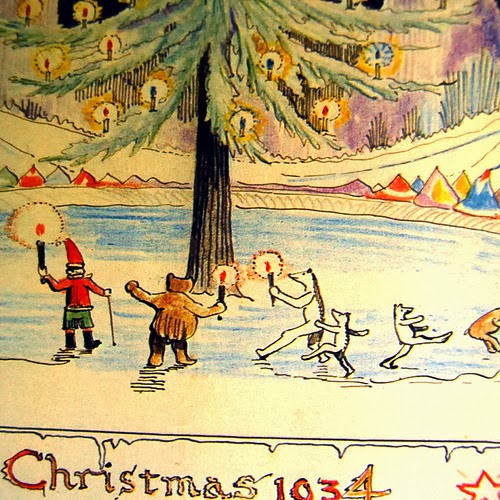
an illustration of Father Christmas at the North Pole by JRR Tolkien


So I was a little dismayed to read this article on CatholicCulture.org, one of my favorite resources for liturgical living:

Many people think that Santa Claus is St. Nicholas "in disguise." Actually the two figures have nothing in common except the name.

That threw a wrench in my dewy-eyed, fanciful plans for integrating the magic of my childhood with the magic of the Incarnation.  If Santa Claus is merely a sanitized, Protestant-scrubbed, secular shell of the real Saint Nicholas, how can I justify continuing the tradition that weakens the life-giving and salvific richness of the Catholic Faith?  Yet I wouldn't deprive my own son of that poignant joy of Christmas that nurtured my imagination and cultivated my soul in preparation for greater mysteries.  Who, indeed, says it better than Chesterton:

What has happened to me has been the very reverse of what appears to be the experience of most of my friends.  Instead of dwindling to a point, Santa Claus has grown larger and larger in my life until he fills almost the whole of it.  It happened in this way.  As a child I was faced with a phenomenon requiring explanation.  I hung up at the end of my bed an empty stocking, which in the morning became a full stocking.  I had done nothing to produce the things that filled it.  I had not worked for them, or made them or helped to make them.  I had not even been good–far from it. And the explanation was that a certain being whom people called Santa Claus was benevolently disposed toward me. . . .  What we believed was that a certain benevolent agency did give us those toys for nothing.  And, as I say, I believe it still.  I have merely extended the idea.  Then I only wondered who put the toys in the stocking; now I wonder who put the stocking by the bed, and the bed in the room, and the room in the house, and the house on the planet, and the great planet in the void.  Once I only thanked Santa Claus for a few dolls and crackers, now, I thank him for stars and street faces and wine and the great sea.  Once I thought it delightful and astonishing to find a present so big that it only went halfway into the stocking.  Now I am delighted and astonished every morning to find a present so big that it takes two stockings to hold it, and then leaves a great deal outside; it is the large and preposterous present of myself, as to the origin of which I can offer no suggestion except that Santa Claus gave it to me in a fit of peculiarly fantastic goodwill.

I think Chesterton would also agree that what the article on Catholic Culture finds distasteful is that which makes Santa endearing and recognizable in a profound way.

Behind the name Santa Claus no longer stands the traditional figure of St. Nicholas but the pagan Germanic god Thor (after whom Thursday is named).  To show the origin of the modern Santa Claus tale let us give some details about the god Thor from ancient Germanic mythology. 
Thor was the god of the peasants and the common people.  He was represented as an elderly man, jovial and friendly, of heavy build, with a long white beard.  His element was the fire, his color red.  The rumble and roar of thunder were said to be caused by the rolling of his chariot, for he alone among the gods never rode on horseback but drove in a chariot drawn by two white goats (called Cracker and Gnasher).  He was fighting the giants of ice and snow, and thus became the Yule-god.  He was said to live in the "Northland" where he had his palace among icebergs.  By our pagan forefathers he was considered as the cheerful and friendly god, never harming the humans but rather helping and protecting them.  The fireplace in every home was especially sacred to him, and he was said to come down through the chimney into his element, the fire. (See H. A. Guerber, Myths of Northern Lands, vol. I, p. 61 ff., New York, 1895). 
Here, then, is the true origin of our "Santa Claus."  It certainly was a stroke of genius that produced such a charming and attractive figure for our children from the withered pages of pagan mythology.  With the Christian saint, however, whose name he still bears, this Santa Claus has really nothing to do.  To be historically correct we would rather have to call him "Father Thor" or some such name.

The article dismisses the modern American Santa Claus as drawing his identity from "the withered pages of pagan mythology," which, I must admit, stupefies me.  Are we talking about the same powerful mythic tradition that taught Tolkien to glorify God Almighty in Middle Earth; that gave C.S. Lewis cause to pause and consider the existence of Truth and the Fall in the soul-shattering phrase, Baldur the beautiful is dead, is dead--?

But surely if Santa Claus has his origins in Thor, he can be found earlier than the 1800's poem and capitalist propaganda.  What about Father Christmas?  He has a totally different name.  Could he have been adapted from Santa Claus, or Santa's predecessor, Saint Nicholas?  And who was that guy in Dickens who appeared with long beard in laurels and robes, with rosy cheeks, calling himself the Ghost (read "spirit") of Christmas Present?


the Ghost of Christmas Present in Charles Dickens's A Christmas Carol


References to a spirit of Christmas go back to the early renaissance.  Ben Johnson has a character appear in a masque reminiscent of medieval mystery plays, in which abstract ideas and attitudes were personified.  He wasn't a giver of gifts--that element belongs to Saint Nick--but a merry-making lord of sorts, a mysterious emissary from an Otherworld that occasionally overlaps with our own during a liminal time (an acceptable time)**, the threshold of winter.  In this guise, he is reminiscent of an enchanted Bertilak in Sir Gawain and the Greene Knight*--which would put his origins back even further, overlapping him with the likes of the Green Man, who is interpreted to be a symbol of the cycling back of life to rebirth in spring.  And what a fitting role for Father Christmas, who heralds the crowning glory of Advent--Advent meaning "coming," and a sometimes synonym for "beginning."  What is the coming of Christ if not the new beginning?

What I found is that the article was right, after a fashion.  Santa Claus, e.g. Father Christmas, and Saint Nicholas are not the same.  Nor does either benefit from the mistaken identity of Macy's famous fat man.  Each is significant, and each has his role to play in Christendom.  Before Advent of this year, I had a sketchy but certain idea that Saint Claus would be our family tradition.  Now I feel differently.

Both are important to the kind of formation in Faith I want for my son: Saint Nicholas, the friend in Heaven and model of Christian charity and steadfastness; Father Christmas, the amalgamation of that most accurately and truly expressed in a benevolent and sometimes dangerous man who, like nature, God's own creation, points to mysteries beyond himself and a reality not yet fully grasped.

We'll have both visitors in my home this year--and, I hope, many, many years to come.  Now all I have to do is figure out the Easter Bunny.


*  Also, Harry Potter's Hagrid, anybody?
**  Kairos tou poiesai to Kyrio.  "It is time for the Lord to act."  When time touches eternity; eternity reaches down into and pierces time.

sig

Liturgical Living: Saint Nick's Day

Dec. 6, Feast of St. Nicholas, bishop of Myra, giver of gifts, protector of children; he is patron against imprisonment, robberies, and robbers; apothecaries; bakers; barrel makers; boatmen; boot blacks; boys; brewers; brides; captives; children; coopers; dock workers; druggists; fishermen; grooms; judges; lawsuits lost unjustly; maidens; mariners; merchants; murderers; newlyweds; old maids; parish clerks; pawnbrokers; perfumeries and perfumers; pharmacists; pilgrims; poor people; prisoners; scholars; shoe shiners; spinsters; students; thieves; and travelers.  I like the image of jolly old St. Nick as protector of thieves and puncher of heretics.


illustration by Elisabeth Ivanovsky // source


Happy Saint Nicholas Day!  We found candy in our shoes this morning, and picture book adaptation of the story of the three poor sisters and the saint.  We made Christmas cards for wounded heroes with friends, and topped the evening by walking downtown to watch the Christmas parade.

I've a myriad of thoughts about Saint Nicholas, Santa Claus, and Father Christmas . . . but it will have to wait until tomorrow because we. are. tired.  So please come back around then.  Our family is still young and our holiday traditions still malleable, and I'd like to hear your thoughts and feedback.

Hope your feast day celebrations and observations were fruitful and jolly!

sig

Name Day

Nov. 16, Feast of St. Afan, a Welsh bishop of the 6th century.


Dear Afon,

Today is your Name Day, the memorial of Saint Afan, who I asked to keep and protect you.  Yours is not the same name as his, but it is close, and I believe we would have named you after him had we known of him.

We didn't chose your name, as such.  I think you chose it.  We had many, many beautiful names for little girls, fresh but traditional, feminine but not fluffy: Nora, Marta, June, Jane, Cora, Cecile, Alice, Gerda . . . even Elfred, after your great-grandmother who taught and Oxford and studied under Tolkien.  Everyone said for certain you would be a girl.  You showed them!

For a boy, we had three: Michael, from your father's middle name (though I was wary of the shortened "Mike"), Jamie, and then a strange one . . . one I stumbled upon in my research somewhere and somehow, and unraveled its history like a good story.  Afon.  The Cymraeg name, for boy and girl, meaning "river," with its many children and descendants flowing and pulsing through the mild, fertile lands of Albion.  One relative in particular holds some reverence with me: that is the river Avon, which hosted a little village that was to host the world's greatest and timeless poet, William Shakespeare.  Unfortunately, that pretty name has been co-opted by American capitalism.  That was my sole hesitation.  But I figured if we kept the Welsh spelling, with an "f" instead of a "v," it would keep enough distance from that brand and preserve the beautiful language of its origin.


Still, we were undecided, and you kept your sex to yourself in your dark, warm world, and slept.

When you were born, and they put you in the clear incubator on my right, and I turned my head and craned my neck to get a good look at you, with your broad, wide face like a chipmunk's and your long, slited eyes (still so exotic looking!), I heard in a clear whisper in my mind, "Afon."  You were Afon, from that moment onward.  And even though I doubted it in the next couple of days, panicking, as a new mother will, with the gentle reassurance of my family, and your father's declining the second choice of "Jamie," I spelled the name over the phone to the woman taking information for your birth certificate.


The relatives and friends in Wales were uncertain of your name.  On more than one occasion, I heard the question, "Is it Afon or Afan?"

I can't remember how long--maybe months, maybe a year later--I found Saint Afan in my internet wanderings and gave a little internal shout.  This was your saint!  He was yours, and you were his, and maybe he nudged me to give you the name, even though it is not an exact match.  You are a little Celtic child, with your fair blond curls and clear blue eyes; your paternal grandmother's Irish blood and nature; and bearing the Welsh language your father loves for your moniker.

There is a an old Welsh story that the young Merlin (himself a Welshman) buried treasure in a hidden cave in the mountains of Snowdonia.  Legend says that it will only be found by a blond-haired, blue-eyed boy of that land.  I half believe that little boy is you.


As a tiny nursing thing, you got so angry so easily and rarely slept!  What a hard time I had of it.  But your nature is not bad, only difficult; clearly you have the artistic temperament.  And you are an artist.  You have decorated our dwelling with numerous colorful strokes and scrawlings.  You can't seem to keep your inspiration contained to paper!

You love the outdoors, and I can't wait to let you lose in the mountains of North Wales, to set you into the forests of daffodils in springtime, to see you splash in the briny Irish Sea.

You love your books.  Well, the reading of them.  You are altogether too rough with them for my liking.

You love to sing.  Words are of no importance to you, and you don't give much credence to them; it's the sounds and rhythm that you cultivate, and I hear you chattering and singing in a jargon only you understand, and probably the angels.

You like sweets and have a deadly attraction to Coke, like your father!

You love Jesus and Holy God and know them, especially the White Round Bread held by the holy fathers at church, and the wooden carving of Christ with his arms outstretched, and the icon of Baby Jesus with His Mother that we light a candle for at night.  We were in the drug store the other day, and you said, "Jesus."  When I looked, there was a picture of Santa Claus and, slightly above and the right, a bearded nutcracker.  "Yes, Jesus," I said, and I was so, so happy.  Yesterday, I wrote the alphabet out on a piece of paper while you watched and recited it in song.  Some you know, others you make up, but when I wrote the t in lower-case, you said "Jesus."


You say your prayers at night to "Holy God" and go through the (sometimes indecipherable) litany of God-bless-So-in-Sos.  Other nights, you just let me do the praying.  Some nights you wake with tears from wretched nightmares, and you want to hold the Jesus cross, either a small icon or my rosary, and then you feel better and sleep again.

My hopes for you are so full and so many.  But I want more than anything else for you to always Know and feel you are loved; to Know the Magic I have come to know and love, in the growing world and in the seasons, in cycles of the Church and in the saints, in books and fairy tales, and in language.  If you become a priest or brother, I will be so happy.  If you wed and have children, I will be so happy.  If you live a fulfilled and chaste single life, I will be so happy.

My little, impish river-child, happy Name Day.  Saint Afan Buallt protect you always.

Love,
Mama


Liturgical Living: Hallowe'en Week

Oct. 28, Feast of Sts. Simon and Jude, Apostles.  St. Simon is patron of curriers, sawmen, sawyers, and tanners.  St. Jude is the patron of desperate situations, forgotten causes, hospital workers, hospitals, impossible causes, and the diocese of St. Petersburg in Florida ( holla!).


It's the opposite of a secret: Halloween is my favorite holiday.

Holiday--from the combination of the words "holy" and "day," meaning a holy day.  If you're Catholic, you know what that is.

(No!  It's not just an extra day to go to Mass in the middle of the week.)

But seriously, I've always been aware of the American Protestant tendency to shun Halloween as "of the devil" and shoplifted from Paganism.  In middle school, I eagerly read and enjoyed the book Save Halloween!, which gave me much insight into the super-conservative Protestant way of thinking.  I also had one or two friends who thought it on par with Satanism.

At the same time, I don't think I've ever seriously given much credence to these claims.  Even before my family enriched their lives by deepening their knowledge and practice of the Faith, Halloween was a precious time for me: a time for gathering in the warmth of home with family; for harvest and good things to eat; for running in the cold until fire burned deep in your belly, warming you from the inside out; for leaping into a kaleidoscope of crisp fallen leaves and the lacework of bare branches; for remembering, through cats and calaveras, that we are more than what we appear; for lighting candles against the growing dark and looking forward to Christmas.  In short, all the good things of childhood; and also a symbol, though one my young mind was yet to fully comprehend, of the temporariness of this world, and the looking forward to the World to come.


Cute, glow-in-the-dark, Halloween themed skeleton pajamas?  We are not amused. 


Well, more and more I've come across, not only Protestant, but Catholic opposition to the celebration of Hallowe'en--that is, All Hallows' Eve--and its liturgical pocket called Hallowmas.

The capable faithful, I am glad to say, have spoken out in disagreement against this Puritain-adopted tendency to repel anything that has remote connections or similarities with non-Christian sources.  Such opposition is a paradox: as we know that the Creator, in a sense, permeates His creation--and that one cannot look around the world and not see the Father reflected in it.

Similarly, the attempts of some of these Catholics and Protestants to reclaim Hallowe'en as a holy day of the Christian Church do so, perhaps unwittingly, at the expense of the reclamation itself--denouncing all ties to pre-Christian symbolism, either real or fabricated.

But more on that later.  This is but the introduction.  As part of my project on incorporating the medieval liturgical year into our everyday living, I intend to designate this entire week of blogging to Hallowtide and Hallowmas: Halloween, All Saints', and All Souls--the autumn triduum, if you will--with tips on how to decorate, favorites, and why I think being scared is sometimes good (hint: it's tied into fairy tales).  And of course lots of photographs!


Making a break with black-and-white motiff and doing a complete 180--lots of orange!


At least, that's my noble intention.  I'm a terrible one for commitments, so we'll see how it all unfolds.  In the meantime, check out what these worthy Papists have to say:


If anyone has any other relevant links, I'd love to know about them!

sig

Liturgical Living: an Alternative Lifestyle

Oct. 1, feast of St. Thérèse of the Child Jesus, Doctor of the Church; popularly known as "the Little Flower."


Hope you've noticed--I've been making note of the feast days for each blog entry these past weeks.  It's a habit I first encountered in a young adult book (highly recommended), Catherine, Called Birdy by Karen Kushman.  In this journal of an English adolescent and daughter of a poor country knight, Birdy conveys her society's saturation with the liturgical seasons.  The book made a lasting impression on me: first, as a novel worth emulating, if I ever wanted to write and publish a story of my own one day; and second, as witness to the beauty and rhythm of the seasons observed by the medieval Church.

In my desire and resolutions to live a more liturgically-focused lifestyle, I've found an excuse to take up Birdy's practice.  And though we've been extremely busy these past few weeks, what with new jobs, colds, fundraisers, and speech therapy appointments, I'm not unhappy with my novice's attempt to live liturgically this Ordinary Time.


Making hot cross buns for Holy Cross Day.  I substituted maple syrup and almond milk, and left out the currants.


They came out delicious!  Even though the crosses made them look more like fortune cookies.


So how does one incorporate the feasts of the Church into everyday life?  In this, I've found two main sources helpful: CatholicCulture.org is an excellent online resource to the liturgical year, with brief introductions of saints and feast days and links to recipes, activities, crafts, and prayers; The Year and Our Children is also helpful to have on hand.

This September, there were hot cross buns for the Exaltation of the Holy Cross (Sept. 14).  I cooked up a huge pot of farfalle with peppers and Italian sausage in memorial of Saint Padre Pio (Sept. 23).  We sang "Good King Wenceslaus" on St. Wenceslaus's day (Sept. 28) and baked tea cookies to honor the English tradition of free tea shop treats on this old saint's feast.  And though I would have liked a devil pinata for Michaelmas (Sept. 29), we made do with Saint Michael's the Archangel's prayers for attacking our colds and defending our good health.

While the secular world moves through its cycles, we are aware of the deeper meanings behind berries and bonfires.


The Harvest Moon is always the full moon nearest to the autumn equinox--this month, Sept. 19, Feast of Saint Januarius.


My son is still young, so we've set aside the crafts for next year.  And while the recipes have been hit or miss, depending on the amount of time they take to prepare and my wellness that day, merely being aware of the liturgical season has placed a peace on me--as one who inhabits a country or climate is more secure, more aware of the lively world around her, assured of her place and role in Creation.

I still read Catherine, Called Birdy about once a year, incidentally, completely by accident.

sig

Theme Thursday: Text


I really like text used as art, which is fortunate because it's a big trend right now.  That's not why I like it.  I like fonts, yes, but it goes beyond aesthetic.  I like the words to have meaning.  I'll be more drawn to a picture frame or a pillow or a Hallmark card if the words are both pretty and meaningful.  And the meaning might only be clear to me; words such as mountain, north, anathema, and cobweb.  Or phrases, such as once upon a time.

There were two versions of the wall art pictured above.  The other one said, "Home Sweet Home," and while I might have liked the art enough to purchase that one, the phrase "Always Blue Skies" spoke much more strongly to me.  It was the kind of thing I wanted to have on my wall, like a magic spell prompting drywall to dissipate into open sky.  The word "blue" paired with "skies" chases away any melancholy associated with the color.  And the word "always" is so affirming, like a promise.


When names appear in text, they declare ownership, character, and function.  Some are even protective or evocative of power.  Like the holy names.  Today happened to be the memorial of the Most Holy Name of the Blessed Virgin Mary.  Our Lady, like Our Lord, has many feast days, each to reverence a different aspect of her role and being.  Depending on the supposed Hebrew version of Mary's name, it means some combination of bitter and sea or lady (as in a royal lady or sovereign).  I don't think believe for a minute that the two interpretations are incompatible.  

"We call Mary our Lady as we call Jesus our Lord, and when we pronounce her name we affirm her power, implore her aid and place ourselves under her protection."

Happy feast day.


sig

3 Reasons I Love Catholicism, Vol. 5

Linking up (belatedly) with California to Korea.


1.  Suffering


The thing about suffering in the Church is, you never suffer alone.

I don't mean that there is always someone somewhere praying for you, though maybe not by name.  I don't mean that you can go to any Catholic parish and a Saint Vincent de Paul Society will tend your material needs while a priest in a confessional hears out your spiritual ones.  I don't even mean the Eternal Presence of Christ in the sacrament of the Eucharist, though that's hardly a mild comfort.

I mean that God Himself knows what it is to suffer; that, if we believe in the eternal sacrifice and know that all of space and time is present before the Most High, God even now is intimately familiar with (what we might call) despair.  And that when our soul's agony cries out to heaven, He weeps with us, saying, "I too have cried out to God, asking why He has forsaken Me."

If I were not a Catholic, I don't know what I'd do with suffering.  It has been Christ crucified, and His silent company, that I've clung to in times of terrible sorrow.

That, and the knowledge that in Catholicism, suffering is not for nothing; it's never wasted.  Suffering can purify.  Suffering can heal.  Through Christ's sacrifice, it is made fruitful.  We can consecrate our suffering and join it to that of Christ on the cross, who said, "Behold!  I make all things new" (Rev.21:5).


2.  Community


Excepting the Arctic and Antarctic circles, and some remote Pacific islands (Pitcairn), the Catholic Church is literally universal.  It can be found in every country in the world.  The apostolic succession set up by Our Lord and the early Church has successfully withstood heresy, rebellion, war, schism, and modernity to remain One.  That's a pretty incredible feeling.  I can wander into a small Swiss village in the Alps one Sunday morning looking for Mass and find an active Catholic parish.*  I can kneel during the consecration of the Blessed Sacrament and be joined in adoration with all the other Catholics that day all over the world, present at the same exact sacrifice.


3.  Ceremony


Human beings thrive on ceremony.  It quenches an instinct as primal as the sex drive, evident from prehistory; surviving through folklore, myth, and artifacts; buried carefully with the beloved dead.  Even atheists happily practice superstitions, and cherish family customs passed down from generation to generation.  Children revere bedtime routines to the point of insisting the babysitter follow Mommy's nightly ritual: bath, book, lullaby . . . and don't forget to tuck her in, just so!  Ceremony is not meaningless but expresses the inseverable union of material reality and spiritual truth.  Since God became man, all matter is sanctified.

The Church recognizes and celebrates this, and gives us ceremony.  She might've interpreted Jesus's command to do this in memory of Me in the simplest of terms.  Many "Bible churches" do.  But every action blesses and enriches.  So the incense and the chanting in Latin; the kneeling and fabric-draped altar; the lips touching crucifixes and colors of candles are for us as much as they are for Him we worship.  We were created as works of art, and our every act of living should be a sublime performance.

Even the simple act of blessing is a ceremony--not a mere thought of good will or a spoken word but a kind of dance.  The lifting of the hand, the touching of the forehead--down to the chest, across the shoulders--to trace a cross in the air, like a magic spell.

----------

*This really happened to me.

sig

Seven Quick Takes: Volume 23

Joining Jen at Conversion Diary for 7 Quick Takes Friday.

-- 1 --


Happy America Day, ya'll.  Hope you had a nice one.  We did.

We bid farewell to the man of the house as he departed on an airplane back to Cymru, to continue pursuing our immigration progression and prepare the way for us to join him (I pray sooner rather than later).

After an early afternoon nap, the Squirt and I joined my folks at the annual part hosted by a prominent family.  People show up each year in the hundreds, each bringing a side dish or dessert.  Beverages, beer, and barbecue are provided by the hosts.  It's nice to see old acquaintances and to indulge in the intimacy only large parties can provide, to quote Jordan Baker from The Great Gatsby.  It really is rather like our Gatsby party . . . the small town version.


-- 2 --


We finished the night with a bloom of fireworks.  About ten minutes, which is a long running time for a private affair.  The Squirt was tired and cranky, but when the lights sparkled, he was quite and paid attention.  It wasn't until the grand finale that he made that slow, deep frown that signified he'd had enough.

Firework-gazing on soft blanket over crunchy summer grass is among my fondest childhood memories.


-- 3 --


The meal-planning initiative is only one part of a greater attempt at honing my life to holy domesticity and liturgical rhythm.  I enjoyed immensely the Byzantine fast this past Lent (as much as one can enjoy a fast--taking pleasure in a worthy sacrifice is more accurate), and I've been looking for ways to incorporate other medieval Church traditions.  I missed Saint John's Day and the fern flower, I'm afraid.  I believe I was working!

Anyway, a Google search retrieved this book, which has apparently been around for a while.  Anyone recommend it?  Is it cutesy crafts or more permeating practices?  I'm open to recommendations.


-- 4 --


You know what is great for keeping the liturgical seasons, though?  Feasts and Seasons, which is aired sometimes on EWTN.  I'm all over these Saint Bartholomew's Day Honey Apples.  And the Saint James grotto might catch the Squirt's attention for a good fifteen minutes (he likes dirt, playing in dirt, rolling in dirt, eating dirt, and rocks).


-- 5 --


Another practice I'm integrating is (almost) daily walks, with the little heathen in toe, strapped into his stroller.  There's a pretty trail in the midst of the city-town, not far from our apartment building, a mile in length.  Getting there, walking down, turning back, and returning home, I'm guessing, adds up to about 2 and 1/2 miles.

Exercising used to be incredibly hard for me; I mean, my body had a physical aversion to breaking down energy, which, in all my twenty-eight years of suffering through it, I have yet to find a modern medically approved term for it (though I meet all the criteria here, modern medicine doesn't recognize this a medical condition).  Now I drink daily all-natural energy drinks, and I'm like a different person.  I enjoy the brisk walk, sweating is not synonymous with slow death, and I don't feel faint and nauseated during and after.  When we get home after the walk, I feel better, not worse.  And I believe that starting the day off with vigorous exercise energizes me for the rest of the day.  And we all know that it helps us sleep better and eat less.

Still not quite ready to jump on the running bandwagon, however.


-- 6 --


I'm looking to purchase candles in bulk because the cheapest votives available around here are $1 minimum, and they only burn for a few days.  I also like to burn candles for recreation and comfort, and as often as I do, they get expensive.  I'm guessing a parish supply store would have affordable deals.


-- 7 --


Congrats to Ms. Hannah!  She was the only person who put a bid in for my copy of the 2012 Tuscany Prize for Catholic Fiction: Collect Short Stories, so she wins by default!  Hannah, please e-mail me your mailing address and let me know if you would like me to write anything special in the in-sleeve when I sign it.


sig

Theme Thursday: Water

Linking up with Clan Donaldson for Theme Thursday.


The classical Greek philosophers taught all of matter was made of four elements: air, earth, fire, and water.  Of these four, water seems to me to be the most instinctive, primitive material.  Alchemists believed that if they could extract the primary element, or spiritual spark, to create the philosopher's stone, and apply a sliver of it to water in a container, all of Creation would occur before their eyes in miniature.  

And then there are mermaids.  The fairy tales of selkies and sirens are a tone more sober than others; closer to home, more possible.  The ocean, for many, was/is such a familiar mystery, the source of boons and punishments.  As is, I suppose any body of water in any form near a people.  The nearby lake or river or spring or what-have-you wasn't just part of the scenery.  It characterized the soul of the community.

Maybe it's some genetic memory of that first life source rising from the water.  Or maybe it's our first sense of being, in the safe waters of Mother's womb.  The sound of water is soothing and unmistakable.  Ocean, rain, and waterfalls are our soundtracks to a peaceful night's sleep.  Water is life.  We must be baptized in water for the Sacrament to be legitimate--even tears are not an acceptable substitute.  Fire purifies, but water generates.  If fire is the spark of life, then water is the passive substance upon which that fire acts.  


Last week's sojourn at the beach provides this week's material.  I wanted to do something different, and just participating in Theme Thursday every week has caused me, without my knowing, to absorb some learning that I would never have had the motivation and commitment to set out to do on my own.  Micaela's self-portraits encouraged me to open up the menacing Photoshop, and Cari's links and edits led me to the Coffeeshop Blog's free PSE actions and spurred me to use them, rather than just look, say "That's neat, I wish I could do that," and then forget about it.

So here is the original photograph.  Not going to stay straight out of the camera because I always augment the light and shadows in Picassa before anything else.  It's very rare that I like an un-edited photo more than a fixed one.  I think that's probably a photography fault on my part, but I'm working on it!


ISO 100, f/1.8


I like the ripples and texture of the water here, how it clings to the Squirt's hand like cobweb.  Okay, but let's try something new.

I applied the Coffeeshop Blog's action Teeny Tiny World, and painted in the Blur layer so that the arm and hand pops out of the background in focus and the rest is muddy.  I thought at first that the lines of the arm bleed into the light because I was sloppy with the coloring tool (I'm an instant gratification kind of girl), but looking at the original picture, I think the combination of some movement and the extreme f/1.8 aperture focus made it that way to begin with.


So there's that, but it's kind of dark and dirty-looking to me.  So I applied the Starstruck action in Photshop Elements and adjusted the layers.  It could have been much more pinky-purple, but I toned that down.  I colored the swim trunks in the layer titled Color Pop, with the opacity pretty low so that it didn't look too obvious (I hope?).

I also activated the layer titled Color Contrast and the layer Matte and fiddled with adjusting opacity.


Without the Matte layer, it looks like this:


But that was a little bit bruise-y, so I replaced the Matte layer and removed the Color Contrast layer.  (Note: you don't have to remove the layers entirely if you feel like the effect is too strong; that's what altering the opacity is for.  A 15% opacity will be much more subtle than a 43%, but still present.)


I liked that one the best, for whatever reason.  Maybe because of the calm, dreaminess of the light and color.  This is the photograph I used with the text way up top, after waxing philosophical.

So my grandmother gave me a very generous check for my birthday, and now the possibility of upgrading (i.e., purchasing) to a more recent model Canon EOS is in my peripheral.  I don't know if I should, though.  I mean, if was going to make a business out of this, even someday, I could justify it.  Otherwise, I have a ton of options, ranging from paying the rent (how responsible) to investing in the chicken egg business everyone's crazy about these days.  Or hoarding it.  You know.

sig

Ghosts


Masha's ghosts that haunt her are the beloved deceased, or else the overwhelming impression on an organic universe of a potent life lived.

Most of the time, I'm too inward to sense emotions outside of me, unless I am aware of a presence to begin with: saints in prayer, God in sacraments, and friends in my home.  Once or twice, I've been aware of crossing paths with a demon, and I don't say that braggingly.  It's an experience I'd a soon as be happy without.  One evening, as I fell into sleep and hovered between the realm of wakefulness and subconscious, a hideous face flashed in my mind.  It was twisted and malformed, and yet . .  it was the only thing which I could ever describe as having all the appearance and features of a human, without a trace of humanity.  I started awake with a whelp.  I shivered under my blanket and Hail Mary'd myself back to sleep.

My youngest sister, however, is very intuitive.  She's been known to hear the clear sound of a voice, unmistakable speech, at night, outside of a dark house in the un-populated countryside.  She is afraid of them, and I don't know whether this is because of her ignorance and innocence or because they are unsavory spirits.  But she knows well the strength of the sacraments and the power of the Holy Name, so I've no fear for her.


She watches a reality television show about a medium living in Long Island.  The woman is a Catholic and talks about praying her rosary and speaking to Mother Mary, so my sister looked up the Catholic position of her type of spiritualist.  A priest instructed that the woman was pure and without blame--if she is able to connect to beings outside of these mortal lives, well, then that is a gift--but he warned that when she made appointments to contact the dead, she went against Church teaching.  Deliberately seeking to communicate with the deceased, going so far as to control them through an appointed time of contact, dabbles in a power one should always lay down before the feet of God.

My ghosts are different.  They're more like desires.  Inverted presences following me around and haunting me and making me miss them.  They are absences.  Distinct holes of things that are gone from my life, whether it be childhood innocence, harmony with God, joy of purpose, or the longing that is so painful and happy I can only hope to be satisfied in heaven.

sig