Showing posts with label wonder. Show all posts

The Flower of the Imagination: a Case for Dragons

May 3, Feast of Sts. Phillip and James, apostles.


{Please note:  This is a Catholic-interest post, I'm afraid, but that doesn't mean non-Catholics can't chime in and/or enjoy.  Just keep in mind that I write from a heavily Catholic perspective and that a suggestion to dismiss moral value in the arts will be a bit irrelevant to the conversation!}

I've been troubled by a literary trend in the Catholic community that draws severe lines of categorization regarding moral archetypes.*  Harry Potter is the obvious example, an engaging albeit imperfect series with some beautiful moments reflecting Christian truth and values.  But the mere mention of the word "witch" cause some to banish it from their bookshelves forever, without even cracking open the cover.

There is more witchy to Harry Potter than the word, I'll grant, but what about other stories that rename symbols or use the imagery from another culture or civilization?  What about the well-loved A Wrinkle in Time, which merely uses the word "witch" tongue-in-cheek to stand-in for celestial beings, perhaps even angels?  What about the wizard Merlin who appears as a sage and a Christian in C.S. Lewis's That Hideous Strength, who is allowed to use the last bit of pre-Fallen Earth's command of nature to save the world and then to pass on?

In the same type of severity, dragons are dismissed as evil in all literature, and any treatment of a dragon as good is an inversion of truth.  As Catholics, we believe that what is not true comes from the Enemy--that is why he is called the Father of Lies.  But are all symbols so iron and non-negotiable?

In the east, dragons are wise and often benevolent, associated with luck and prosperity.  It's hard to say that this is an inversion, since the civilizations of Asia are far older than those of western Europe, except in the sense that they're symbols are opposite ours.  Which would only make sense, as we are on opposite sides of the globe.

But, people argue, in the Bible the serpent is cursed by God, and should always be associated with evil. Well then, say I, what about Moses's use of the snake on the staff--not even a real snake, but a seeming idol!--to heal and perform miracles?  With this task he was charged by God Himself.  It seems that even in the same cultures, sometimes symbols can be inverted.

There's a similar case for witches.  According to the Oxford English Dictionary, the word witch first appears without any negative connotation; it's not until several centuries later that a second usage appeared that was more or less synonymous with the idea of witches we have today--devil-worshipers or evil spirits (citation as soon as I get back to the library).  Even then, the clear-cut dichotomy of magic being always evil did not exist** and in fact didn't become the majority belief until the late Middle Ages.  Before then, the belief in the supernatural other than God lived side-by-side with a deep devotion to the Church.  One need only look at Ireland as late as the first half of the twentieth century.

I have a theory that the reason why no one saw a problem with this apparent hypocrisy was because it was kept in the proper order: God was Lord.  And the other creatures or ways were rendered impotent, with the sign of the Cross or a a consecrated Host.  Dracula illustrates a superb example of the sovereignty of Christ.  Modern supernatural thrillers would be over a lot sooner if they'd just call the exorcist to bring in the Eucharist.

Vampires are another archetype enjoying a great revival at the moment.  Though as far as I know, vampires have in every time and place been on the evil spectrum of archetype, I have no problem with the modern obsession of redeeming them . . . so long as it is done believably and does not indulge in what Flannery O'Connor calls "sin against art."  I think clinging to the original archetype of the vampire as something dangerous, depraved, and hungry for redemption (John 6:54, anyone?) is what makes him so attractive to modern readers--not that the archetype is inverted so that vampires now appear good rather than bad.***  Our generation is all too familiar with the attractiveness of evil . . . aware of the that strong, thin thread of the Holy Spirit, calling us to salvation.

When I was younger, I used to believe that there were far more absolute truths than there actually are.  Absolute truths about what is beautiful and modest, what is the proper form of worship, who is in the right and wrong on particular political and philosophical issues, even absolute truths in parenting.  But experience and gentle discipline from God have taught me otherwise.

That is not to say that we shouldn't approach our reading material with caution: those with sound formation have a far greater chance for sifting the truth and beauty from the trash and poison in modern literature.  Those struggling or with young children have greater need for discernment.  But if we sweep all stories with non-evil dragons, benevolent witches, and less-than-saintly protagonists into the same off-limits categories, we risk experiencing the deepness that is the story of our Redemption.  We skip to the Resurrection at expense of the Cross.  

We must find a way to kill the weed without uprooting the flower.

------------


*  For further reading, see A Landscape with Dragons by Michael O'Brien.  (Kindle version available here.)
**  I've twelve months of post-graduate study on Arthurian literature and a Master's thesis under my belt to affirm the ambiguity of the magical figure in the Dark and Middle Ages.
***  I speak with limited knowledge on the subject, as I have not read the grandam of supernatural romance, the Twilight series.

sig

Flower Seasons

May 1, Feast of St. Joseph the Worker, St. Walpurga, May Day, and Mary's Day.


Last evening, we celebrated St. Walpurgis's Eve with a romp on the beach.  Afon ran straight for the cold waves, shoes, socks, trousers, and all.  I had to run in after him (shoes, socks, trousers and all) but he was not dismayed.  Until later, when he realized how uncomfortable it was to be wet, even on a mild evening in spring.

When the tide is out, the rocks are things of beauty, and for all the white-sugar sand of the Gulf coast of Florida, it doesn't touch the raw, remote, mineral beauty of the Irish sea.  Pebbles are worn smooth and creamy from the patient centuries.  It's a hard kind of thing to capture with a camera, so I'm glad I left it behind this once and enjoyed being in it.  The beauty of the Welsh seashore is a dimensional thing; it's in the atmosphere, a haziness that color and line and form can't quite capture.  The mussels sprout like so many blossoms on the jagged rocks.

I've always counted the seasons of Wales in flowers.  The sign of winter's waning is marked by the coming of the snowdrops.  We arrived in March, just in time for the daffodils.  They're season fades for the time of the bluebells, and they are even more numerous than Saint David's flower.  Soon the hydrangeas will harken the summer.

But there are many, many flowers here, the apple blossoms, tulips, dogwood, and primroses.  I think this is a Kazan Flowering Cherry.  They appear in lush poms and snow torrents of true-pink petals.  The trees are here and there in Colwyn Bay, but this one is at the entrance to Tan-Y-Coed gardens along the Old Colwyn river.

sig

Liturgical Living: Not Like Any Other Night

April 18, Holy Saturday.


I spent most of the day Thursday cooking a (sort of?) traditional Sedar meal for our little family.  I've celebrated a Sedar meal before but never hosted one myself, but living intentionally and liturgically this past year has given me the courage to attempt bigger and bigger projects.  Also, I couldn't have done it without the Academy: my husband, John, who went out twice to different grocery stores to fetch me ingredients and the normally functioning oven, a great improvement to the Florida stove that burnt everything if I didn't shave off a fifth of the baking time in every recipe and the fire alarm that sounded at the slightest provocation and slight rise in temperature, not to mention normal steam and the occasional sparse smoking.

I got all the recipes from CatholicCulture.org, which has become a staple resource in my intention to live liturgically.


The matzah bread was so easy and came out beautifully, if not as flat as what you can buy in the store.  I don't think north Wales has a very large existing Jewish population.)  The only flour I had was self-rising flour, and we make use of what we have around here.  Especially after spending what we did on a leg of lamb.  (More on that later.)  My father-in-law called the "matzah" rustic (compliment).  It only uses three ingredients: flour, water, and salt.  It was so easy and tasty, I'm going to make this flatbread throughout the liturgical year, I think, and season it with green herbs, like this fresh thyme we have growing the back garden, and slathered with butter.


The matzah is the unleavened bread.  And, no, it is absolutely not a coincidence that this setup looks like the host and paten at a Catholic Mass.  The parallel is utterly intentional.

Chopped apples and nuts soaked in wine with sugar and cinnamon make charoses, meant to symbolize the mortar that the Hebrews made when they were slaves in Egypt.


The egg is for new life, and the "bitter" herbs dipped in salt water reminiscent of the bitterness of our Hebrew ancestors in slavery.  (We also couldn't find horseradish.)

Before preparing this time-consuming though uncomplicated meal, I printed out coloring pages for Afon from Catholic Icing, a great resource that I'm sure everyone's already heard of.  Maybe in a few years' time, we'll cut out the figures and make the small-scale of DaVinci's Last Supper.


He thought all the apostles were "Jesus."  You know, the beards and all.


I'd never made lamb before, so I opted for well done with only the slightest bit of pink around the bones.  The recipe calls for sweet marjoram and cloves, but neither were available, so I substituted oregano and some cinnamon.  We did have brown sugar.  Lots and lots of brown sugar.


That evening, John, as the patriarch of the household, enacted the role of the leader.  There comes a point in the ceremony when he breaks the bread and puts the larger part under a napkin where it is hidden, to represent the Messiah who has not yet come.  But as Catholics, we break from tradition, and eat of the hidden bread before the ceremony ends, reciting the words of Jesus at the last supper: "Do this in memory of me."

You see, our Jewish brethren come to the table of Passover with expectation and remembrance.  They are mindful of their suffering and how God liberated them when they cried out for help.  But we remember not only the exile in Egypt but the exile of Original Sin; how God offered us His Own Son as the spotless lamb to be sacrificed, to be eaten of, to spread His Blood on the wood of the cross rather than a lentil, in order to loose the chains of our spiritual slavery.  And He invites us to eat Him, each time a Mass is said, for "my Flesh is food indeed and my Blood is drink indeed."


"You see, Afon," I said, "this is what the priest does at church on Sunday, up on the altar.  It doesn't look quite like this, but this is what it is.  Only what we eat now is just a meal.  But what we eat at the Mass is not just a meal; it is true magic.  The kind of magic that makes flesh look and taste and smell and feel just like bread and blood look and taste and smell and feel just like wine.  So that Jesus can come into our mouths and go down into our tummy and be with us for the rest of the day, closer than our own heart, and nourish us there.  Because He loves us very much."

And throughout this pretty speech, Afon banged his fork and knife on the table and relocated to the couch.  But I figure after a few years of this, understanding--or, at least, the best kind of understanding a mere mortal can hope to have of the mysteries of the universe--will sink in by osmosis.

A blessed Easter Triduum to you and yours.

sig

Trying to Be Happy Now (Rather than Later)

April 10, Feast of St. Fulbert, bishop of Chartes, author of hymns, treatises, and letters.


I found out that what I thought was the Fairy Glen was not actually the Fairy Glen, but Tan-Y-Coed, a little sea-side garden where all the daffodils grow like many bright-bonneted ladies.  The Fairy Glen is much wilder, a little farther on, actually right alongside the road where we live, following the River Conwy--Afon Conwy, as it is called, and I'm beginning to think it a premonition that I named my son Afon.

I can hardly believer we're here, at last.  But already I find myself growing restless, eager to move and walk, alert for any whispering in the trees and itching to get just over the next hill, the next bend in the path, the next bay . . . until I walk myself right to the shore of the salty sea, and still, still, I think my feet would keep going into the waves if my mind didn't stop them.

Like departing paths, my plans keep branching out before my eyes, and before I can even stop to write them down or pause to consider them, they've taken to foot and run away with me.  They hold up little mirror-visions, like paintings on a merry-go-round: of me owning a spinning wheel and making my own yarn and thread, learning to fillet crochet, opening an Etsy shop to sell my ink scrawlings on the back of post cards, keeping a sketchbook with me at all times to improve my drawing, starting a photography business, moving into an old-but-cozy cottage somewhere between the mountains and the sea, then caring for sheep on a farm, and even a stretch of time spent in Swiss Alps, maybe a certain time of year, of climbing mountains, of climbing Mount Snowdon, of walking tours, and hiking around the coast of Anglesey, and as many fancies as there are flowers, spinning and dizzying.

The road goes ever on and on. . .

I'm not saying that's necessarily a bad thing, but I am afraid that it takes me away from what matters: from the beauty of now, the spring sun all water-clean and my son's fading chubbiness and growing vocabulary.  Why didn't the moment of late afternoon on the hill cliff over the ocean satisfy?  And wasn't planting flower seeds in dark soil with Afon a rich piece of my previous dreaming?  Why have the things I've done yesterday fled so soon?

I guess this is our mortal lot in life.  To always be wanting and looking forward, always searching, never satisfied.  C.S. Lewis calls it joy, but--!  I never imagined joy to feel so sweetly painful.  And how do we as Christians reconcile, when we know that we will ever only truly be happy in Heaven, with the peace that surpasses all understanding?  And is it okay for me to always be looking forward?  Is it ungrateful and wicked not to be satisfied with Now?

I sometimes believe nothing short of an elf-ship setting sail to the Undying Lands--Westernesse, Atlantis, Avalon, Brocéliande, or what have you!--would satisfy.

sig

All Their Wars Are Merry

March 15, Feast of St. Longinus, who converted to Christianity after piercing the crucified Christ with a spear and saying, "Truly, this was a good man."


Chesterton had a remarkable gift for seeing people.  I mean really seeing them, at once, without the veils of ego, stereotype, and assumption.  Such a gift gained praise from the biographers of the greats, such as Thomas Aquinas and Charles Dickens.  In the case of the former, the aneqdote goes that GK had never read Aquinas before, so he had his secretary bring him a stack of books on and by the Church doctor.  He opened the cover of the first book on the top of the stack, read for a few hours, flourished his pen, and immediately began to write what is considered the most comprehensive work on Saint Thomas Aquinas.

His gift of perception not only applied to people but to peoples.  His straightforward way of communicating his clear-sightedness has won him lots of criticism from those sensitive to the persecuted races and ethnicities.  But in my reading (which, admittedly, is not exhaustive), I've never known Chesterton to speak of a person or people without genuine affection, and never with any layer of subterfuge.  It is his innocnecne and clarity, as if he were remarking, very fondly, about the weather, that makes it alarming--almost offensive.  All the more alarming, then, when you find that what he says is true.

Chesterton was a firm advocate of the Irish cause and inspired their leaders to aspire to independence.  In these brief lines from The Ballad of the White Horse, he strikes on that peculiar Irishness that otherwise is difficult to put into words, so I really shouldn't even try.  Suffice to say that as one familiar, through intimate study and some travel, with the Gaels (and their brethren, the Welsh Celts!), Chesterton is right on the money.

I think this attitude of the Gaels offers a glimpse into the mystery of what makes them so Catholic.  It took Saint Patrick a mere forty years to preach to and convert Ireland, a feat only matched (as far as I know) by Our Lady in Mexico.  There is something very Catholic about merry wars and sad songs; the knowledge of the victory already won and the cheerful soldier, the ballads of mourning for a paradise not-quite-remembered.  If the conversion of the Irish was steady and remarkably peaceful, I think it was because there was something in the Irish that was remarkably receptive to Catholicism.

And if the Irish were already, in a profound and unnameable sense, Catholic, then perhaps it's fair to say that every Catholic is a little bit Irish.  c;


Linking up with Amongst Lovely Things for Weekends with Chesterton.
sig

Missing the Heart of the Fairy Tale

A Review of Disney's Frozen


Guys, it's moving week, so here is another lazy re-blog from Spinning Straw into Gold that I thought you might enjoy.

------------

I should be sleeping, or reading Harry Potter and the Prisoner of Azkaban, but I stumbled upon this review of Frozen and remembered that I had similar things to say about it.  So.

I liked Frozen.   It was funny, sweet, and well-animated, if a bit buggish (whatever happened to the beautiful, graceful characters from original Disney, making appearances as late as Princess Tiana?).  The songs weren't particularly moving, but I did get the refrain do you want to build a snowman? stuck in my head, so I suppose it was effective.   It takes place in a clear and easy-to-pinpoint location with decent attention to the visualization of culture and customs.   Being a fan of folk culture, and especially Scandinavian folk culture, I enjoyed that part of the film immensely.  But for our purposes here on Straw into Gold, it is imperative that I communicate the residual impression it left with me, which was this: Frozen was not, except by a deft maneuvering of the imagination, a fairy tale.

My problem with Frozen is that it was virtually gutted of all things Faerie.

I don't mean that it was hardly recognizable from its inspiration, Hans Christian Anderson's The Snow Queen, although it was that.  I mean the magic was all but absent.

Oh, there was magic, as in the powers of Princess Elsa to make ice and snow from the touch of her fingertips.  But there was an utter lack of the magic of Faerie; the sense of and cautious reverence for the Otherworld; of danger from an almost-but-not-quite pernicious sentience; of the fickle, and uninterested, yet inexplicably connected existence just beyond the reach of of our own.  There was no alarm at Elsa's powers or inkling that something deeper was going on in relation to them (the curse of a slighted fairy, or the residual trait of an ancestor's mingling with gods); and even the characters' fear of Elsa was not found in the nature and source of the powers but in her potential to do damage with them.  After the ball scene when the new queen's secret is revealed, Anna doesn't even pause to wonder at this astounding development; it's all par for the course.  "So that's why she's shut me out all these years."  O-kay.

Granted, in traditional fairy tales, fantastic events are often presented without any commentary on their fantasticness.  But the fairy tales never mean to make the fantastical belong to the mortal.  There is always an explanation of sorts, even if that explanation shuts out further investigation, like the lid of box snapping shut on a hand.  "She was actually a faerie changeling in disguise."  That's it, that's all that's needed.  A recognition of the Other, of some always-and-ought-to-be unknown.

Even the trolls are pared down to their lowest common denominator, emptying them of all the mystery and danger of the otherfolk and making them mere comical, cartoonish creatures.

Finally, the glass shard in the heart* loses its potency.  Rather than darkening the sight of Anna,** the shard in the eye (generalized to "head" in the movie) only knocks her unconscious and turns white a strand of her hair.  All her memories have to be erased so she forgets her sister's gift-curse and doesn't question Elsa's separation from her.  But that is a secondary, and not a direct, result of the ice shard.  The second ice shard slowly freezes Anna's body but leaves her heart untainted.  What kind of congress with Faerie only touches the outside of a person, only his physical existence; leaves his perception of the world unshaken?

When Anna finally reaches the palace of her ice queen sister, it is opposite of what little Gerda finds when she arrives at the sheer and terrible fortress of the Snow Queen.  Anna finds only a very human girl, with very human hurts and emotions and fears, and the rest of the palace empty.  But Gerda finds the Snow Queen absent--as her nature, one might say, is a great, gaping absence--and dear Kai with his soul half-killed, working away mechanically at a puzzle made of shards of ice, trying, yet ever failing, to form the word eternity.  Anna's act of sacrificial love for her sister Elsa breaks the spell, as one would expect.  When Elsa feels and knows her sister's love for her, her frigid emotional walls falter and crumble.  It is a self-administered cure.  But when Gerda finds poor Kai enslaved to logic--the ice-cold logic of the mind, of science, of nature, and of seasons--her shed tears melt his heart and wash loose the shards of glass.

For Faerie is vast and fierce, and we often tremble before it and believe ourselves helpless.  But in this, the heroes and heroines of fairy tales prove us mistaken.  We are not helpess.  Faerie is wild but not immune to obeisance--for those with stout hearts and stubborn wills, though the winter seem endless, and the journey long.


* changed from glass to ice in the movie, so as to remove the uncomfortable and politically incorrect hell-mirror-falling-from-heaven scenario
** who is the combination of Kai and Gerda from Anderson, though Elsa, the Snow Queen figure, has bits of Kai in her as well


sig

The Secret of Kells and the Art of Making

Feb. 1, Feast of St. Brigid of Ireland, the Mary of the Gael, who, among many other miracles, when she asked for land, was granted all that her cloak would cover.  When she lay down the garment, it spread for miles.  She was born into a high Druid family and was instrumental in the smooth transition between the the old ways and Christianity.  St. Brigid is patroness of blacksmiths, boatmen, cattle, chicken farmers, children whose parents are not married, dairymaids, dairy workers, fugitives, infants, Ireland, mariners, midwives; milk maids, newborns, nuns, poets, poultry farmers, printing presses, scholars, and travelers.


The Secret of Kells by Carton Saloon
(image source)


In honor of St. Brigid's Day, I'm sharing an old post from my other (often neglected) blog, Spinning Straw into Gold.  Though the holy marriage of fairy tales and the Faith is not immediately obvious, the signs are there for those who pay attention.  I hope, if you like these thoughts, that you'll consider clicking over to Straw into Gold from time to time, where I happen to headquarter my third of our lively Harry Potter book club.

------

I've only recently encountered this delightful animated film from 2009.  The Secret of Kells is about a boy growing up in the walled abbey in Ireland during the time of the Viking raids, while the Book of Kells was being penned and illustrated.  It was an instant favorite for my family, and we play this song to our little one all the time.


This clip shows the highly stylized animation that evokes traditional Irish art.  Much could be written about these exquisite and deceptively simple illustrations.

The plot is straightforwardly simple, so much so that I was a bit surprised when the credits started rolling.  However, after stepping back from the experience of viewing to examine the whole, a clear theme emerged: that of the perseverance of human nature and its ability to create art in spite of trial.

The Book, not yet known as the Book of Kells, arrives in the abbey fortress with the famed illuminator Aidin, sole survivors of a Viking raid to the island of Iona.  Brendan is told by his uncle Cellach to keep away from the Book, as well as the forest that creeps up to the very threshold of their settlement.  Both are dangerous in different ways.

Cellach's intentions are worthy enough; day and night, he labors over the design and construction of an immense wall, intended to hold out the Vikings and defend the abbey and those who look to it for protection.  But the lure of the Book's mystery speaks to young Brendan.  Once he glimpses the fantastic illustrations, he longs to be a part of its making.  He risks disobedience at Aidin's behest and ventures into the woods to find berries for ink.  There he meets Aisling, a native faerie, who befriends him and teaches him the mysteries of the wood.  As Brendan's knowledge grows in the art of illumination, so does his appreciation for the art of the natural world.


source


The Secret of Kells is about pushing through adversity to continue making; about the human soul reaching out for beauty, and the way art transforms, even as men and women transform the materials around them into something new, especially works of art.  

In times of trial, we are tempted to point a finger at the dreamers and idealists; it is hard to see what the value of art is in a world of destruction.  Beauty and utility clash.  What good is a lovely song or a moving picture when death lurks at the end of every day?  This is the abbot's unspoken question in Kells.  Cellach, the abbot of Kells, was once an illuminator himself.  Jaded by hardship and worry, he forsook it and took up the task of building a wall to protect those under his care.  So desperately does he try to preserve life at any cost, he shuts out that which does not directly contribute to that aim.  He banishes his sense of wonder and refuses to acknowledge beauty.  One cannot eat a poem, he reasons.  A painting cannot stave off death.

What Cellach believes will protect him, however, ultimately proves useless.  Only, having shirked joy and the hope inherent in creating things solely for beauty's sake, he has failed to treasure the gifts and talents (and people) he had while he had them.  He has neither safety, nor hope.

Fortunately, the film doesn't end on the wasted Kells and the empty abbot.  Brendan, who, with a child's innocent wisdom, recognized in his own way the importance of the Book, facilitates his uncle's reconciliation with truth and beauty before the end.

It's a well-made, thoughtful movie, and I highly recommend it.  Whether intentionally or not, The Secret of Kells speaks to why we should still tell stories, especially fairy tales.   Our voices matter, and our efforts are not made in vain; just as the aged monk's were not, who could not have guessed the profound richness with which he endowed humanity, when he first picked up ink and quill.

sig

2013

Dec. 30, the Sixth Day of Christmas.


I worked a full day today.  It's an odd thing, rising in the dark and going about your business as the sun lumbers its path, and then returning home just as the blueing sky returns to darkness.  The world seems small somehow, more self-contained.  Your life is suddenly book-ended by night.  And the funny little things we do so importantly in the day feel prim and trite.  Where did the light go?  I saw it come and leave, almost in one breath; one puff.

Out, out--!

So too the year's snuffed.  Unlike 2012, where my accomplishments were tangible and/or large enough to be accounted for--moving into our own apartment, setting up house; writing the first draft of the Story, noted for the Tuscany Prize; gathering a small but (in my opinion) impressive group of followers over on Spinning Straw into Gold and laying the foundations for titanic and life-long friendships--2013's have been more subtle, internal.  But the internal changes are the most lasting, aren't they?  I've come a long way, I think, in a year.  I've got stronger, learned some things about myself and loved ones.  Juggled a demanding part-time job with child-rearing, housekeeping, and bill-paying.  Been held by others at my weakest and held others up in my strength.  Been less defensive, asserted a little more.  And, more than ever, it's become clear to me where and how I want to continue on my road.  Life gets more and more pointed; doors close; the way is whittled down until it is one small twig and only two things remain, to go the direction in which it is pointing or not:

"The issue is now clear.  It is between darkness and light, and everyone must choose his side."  G.K.C.'s last words.

I don't think God gives us dreams for them to stay dreams.  We choose the darkness when we cling to them and horde them, instead of offering them up to Him, where He can cup them in His mighty hands and breathe life into them.  It takes quite a bit of faith to hand over those fragile dreams.  But I have to believe that God wants for us what is good.  He wants for us what we want, if what we want is pure and true to ourselves, and not a distortion of that first thrill in childhood, corrupted by the world's faithless hands.

This year, I'm going to continue working on the Story.  I won't say I'll finish it because a thing like this is furtive and doesn't do well under direct pressure.  It has to be coaxed, loved into being.  I'm going to pray more.  I mean really pray.  I want to stay off the computer and the internet and read more, walk more in the open air.  To take exercise, as long as the reason for it is anything other than to take exercise--what a terrible reason!  No wonder I hate it.  One should run because one loves the thrill of running, the pounding of feet and the sweet burning of the lungs; one should swim because one wants to beat the waves like a primal being; and one should kick or swing or hit or dunk a ball because it is Such Fun to put a ball into a target, to say, with the angels, "And do this!" and to watch it happen!  I want to care less about if I'm pleasing others and more about if I'm pleasing God, and myself.  I want to form my son, in mind, body, and spirit, so that at my end, despite my own pitiful failings, I will be able to point to this one good thing and say, "God, he is Yours."  I want to make things with my own hands; this secondarily to the writing, but when the choice is between consuming or producing, I hope to chose to make; unless I am in need of rest, and even then, there is prayer.

I want to do all these things as if there's no time in the world and all the time in the world--each new thing with urgency, frivolity, intensity, and attention.

------------

Tomorrow I'm going to post 13 pictures from 2013 that tell the story, in one way or another, of my year; no words allowed.  I used to do these "little stories" more often but have been so busy of late (and often ill).  That's another resolution: to post more wordless stories to this blog, to be aware of the daily stories I live and to appreciate them enough to capture them on camera.  After all, writing words are second nature to me; and it pays to get a little out of one's comfort zone from time to time.

Won't you join me?


sig

Nadolig Llawen!

Dec. 24, Vigil of the Nativity of Our Lord.


". . . there is a veil covering the unseen world which not the strongest man, nor even the united strength of all the strongest men that ever lived, could tear apart.  Only faith, fancy, poetry, love, romance can push aside that curtain and view and picture the supernal beauty and glory beyond.  Is it all real?  Ah, Virginia, in all this world there is nothing else real and abiding."

Christmas blessings to all who visit this blog and all their loved ones, and to our Eastern and Greek brethren, the same hearty sentiments in a few weeks' time!  Nadolig llawen!

sig

Theme Thursday: Dreaming

Dec. 18, Wednesday of the 3rd Week of Advent, Day Three of the Christmas Novena.


f/1.8  //  ISO ???  //  ???


Can you totally tell this is tampered with in Picmonkey to make it look like snow?

I'm dreaming of a white Christmas.

As I write this late(ish) on Wednesday night, sleepless and uncomfortable from yet another virus, I'm predicting that the popular Christmas song (and movie!  twice!) is Cari's inspiration for this week's Theme Thursday.  Sadly, there will be no snow for us this Christmas, lest glacial melting and global warming take vengeance and usher on the Apocalypse . . . and that's just no fun and not what I had in mind for Jesus's coming, even the second one.

But I do dream of white Christmases, and dreaming is memory--at least, they must come from the same place in the soul.  And even though I now live in a sub-tropic clime, I'm a child of Midwestern winters, and the hard, warm snow that fell on flat, dry grass, lending its porcelain silence to a drab and weary backdrop.

I remember waking in the dark of early morning, breath held.  Even if no word came from the television that school was canceled due to snow-blocked roads, I still thrilled to step out into the white-and-black world.  Snow makes stars sharper, somehow.  I'd bundle up and go out early to wait on the corner of the street.  My feet were the first imprint; it was surreal, like crossing finest sand on a beach no human soul had touched on another planet.  Everything was suddenly closer, the world made smaller; you know, sharper, like when you twist your camera lens and everything comes into focus, so that you can see each tiny grain of glass.  As if the light reflected drew the sky down to gaze at her own reflection.  I stood there for ten, fifteen--twenty minutes well before I had to; before the other children--noisy, shoving and joking, oblivious--came out to wait with me; before the squat bus lumbered over the road toward us, and broke my shimmering bubble of infinite yet self-contained existence.

I mean, there's more than one reason it's called a snowglobe.

sig

Liturgical Living: What to Do about Father Christmas?

Dec. 10, Feast of Pope St. Miltiades (Melchiades).  Tuesday of the Second Week of Advent.


I grew up acquainted with Santa Claus.  Christmas Eve was better by far than even Christmas Day because the expectation and the ideal of the luxurious presents in colorful disarray beneath evergreen boughs was by far better than the reality--though that was pretty good, too!  And what could have incarnated and represented this sweet expectation better than Santa Claus?  That mysterious resident of Faerie, good-natured but not permissive, who defied all science (though not the logic of the human heart) and visited every single house in the world in one breathless night, bestowing gifts to good children in homage to the Christ Child?

I knew Santa was sometimes called Saint Nick, but I learned of the historical saint much later.  As I fell deeper in love with the Faith, I was tickled and proud that our own dear bishop should be the source and inspiration for my beloved childhood friend.  Interest in foreign cultures and anthropology introduced me to many delightful traditions regarding Nicholas and Christmas--including the medieval liturgical celebration of his feast on December 6th, still observed in some European countries.

Meanwhile, Father Christmas, understood to be more or less Santa Claus's British counterpart, endeared me to him in the sacred stories of my adolescence.  To this day, the phrase "always winter, never Christmas" gives me delicious chills, causes me to crave Turkish delight, and attracts me to wardrobes.

Now my own son is coming of age, that holy age of unbridled imagination.

Last year, Father Christmas left him candy and presents in an over-sized stocking; last week, Saint Nicholas tucked sugared oranges and miniature candy canes into his little shoes.  I want to submerge him in the alternative lifestyle that is the Church calendar and teach him the mysteries of human story; for for me, the realm of Faerie and the Truth of the Faith are not mutually exclusive.  On the contrary, I don't believe I could even approach one without the other.


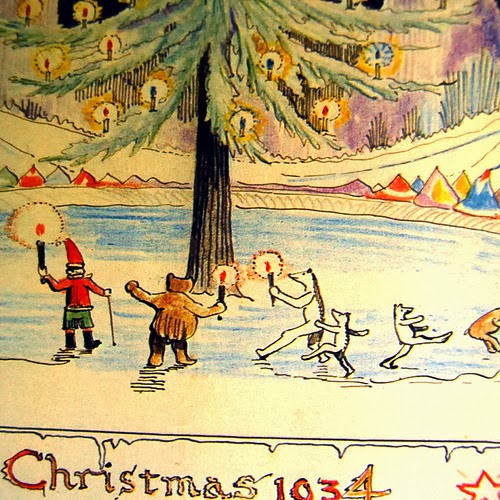
an illustration of Father Christmas at the North Pole by JRR Tolkien


So I was a little dismayed to read this article on CatholicCulture.org, one of my favorite resources for liturgical living:

Many people think that Santa Claus is St. Nicholas "in disguise." Actually the two figures have nothing in common except the name.

That threw a wrench in my dewy-eyed, fanciful plans for integrating the magic of my childhood with the magic of the Incarnation.  If Santa Claus is merely a sanitized, Protestant-scrubbed, secular shell of the real Saint Nicholas, how can I justify continuing the tradition that weakens the life-giving and salvific richness of the Catholic Faith?  Yet I wouldn't deprive my own son of that poignant joy of Christmas that nurtured my imagination and cultivated my soul in preparation for greater mysteries.  Who, indeed, says it better than Chesterton:

What has happened to me has been the very reverse of what appears to be the experience of most of my friends.  Instead of dwindling to a point, Santa Claus has grown larger and larger in my life until he fills almost the whole of it.  It happened in this way.  As a child I was faced with a phenomenon requiring explanation.  I hung up at the end of my bed an empty stocking, which in the morning became a full stocking.  I had done nothing to produce the things that filled it.  I had not worked for them, or made them or helped to make them.  I had not even been good–far from it. And the explanation was that a certain being whom people called Santa Claus was benevolently disposed toward me. . . .  What we believed was that a certain benevolent agency did give us those toys for nothing.  And, as I say, I believe it still.  I have merely extended the idea.  Then I only wondered who put the toys in the stocking; now I wonder who put the stocking by the bed, and the bed in the room, and the room in the house, and the house on the planet, and the great planet in the void.  Once I only thanked Santa Claus for a few dolls and crackers, now, I thank him for stars and street faces and wine and the great sea.  Once I thought it delightful and astonishing to find a present so big that it only went halfway into the stocking.  Now I am delighted and astonished every morning to find a present so big that it takes two stockings to hold it, and then leaves a great deal outside; it is the large and preposterous present of myself, as to the origin of which I can offer no suggestion except that Santa Claus gave it to me in a fit of peculiarly fantastic goodwill.
I think Chesterton would also agree that what the article on Catholic Culture finds distasteful is that which makes Santa endearing and recognizable in a profound way.

Behind the name Santa Claus no longer stands the traditional figure of St. Nicholas but the pagan Germanic god Thor (after whom Thursday is named).  To show the origin of the modern Santa Claus tale let us give some details about the god Thor from ancient Germanic mythology. 
Thor was the god of the peasants and the common people.  He was represented as an elderly man, jovial and friendly, of heavy build, with a long white beard.  His element was the fire, his color red.  The rumble and roar of thunder were said to be caused by the rolling of his chariot, for he alone among the gods never rode on horseback but drove in a chariot drawn by two white goats (called Cracker and Gnasher).  He was fighting the giants of ice and snow, and thus became the Yule-god.  He was said to live in the "Northland" where he had his palace among icebergs.  By our pagan forefathers he was considered as the cheerful and friendly god, never harming the humans but rather helping and protecting them.  The fireplace in every home was especially sacred to him, and he was said to come down through the chimney into his element, the fire. (See H. A. Guerber, Myths of Northern Lands, vol. I, p. 61 ff., New York, 1895). 
Here, then, is the true origin of our "Santa Claus."  It certainly was a stroke of genius that produced such a charming and attractive figure for our children from the withered pages of pagan mythology.  With the Christian saint, however, whose name he still bears, this Santa Claus has really nothing to do.  To be historically correct we would rather have to call him "Father Thor" or some such name.

The article dismisses the modern American Santa Claus as drawing his identity from "the withered pages of pagan mythology," which, I must admit, stupefies me.  Are we talking about the same powerful mythic tradition that taught Tolkien to glorify God Almighty in Middle Earth; that gave C.S. Lewis cause to pause and consider the existence of Truth and the Fall in the soul-shattering phrase, Baldur the beautiful is dead, is dead--?

But surely if Santa Claus has his origins in Thor, he can be found earlier than the 1800's poem and capitalist propaganda.  What about Father Christmas?  He has a totally different name.  Could he have been adapted from Santa Claus, or Santa's predecessor, Saint Nicholas?  And who was that guy in Dickens who appeared with long beard in laurels and robes, with rosy cheeks, calling himself the Ghost (read "spirit") of Christmas Present?


the Ghost of Christmas Present in Charles Dickens's A Christmas Carol


References to a spirit of Christmas go back to the early renaissance.  Ben Johnson has a character appear in a masque reminiscent of medieval mystery plays, in which abstract ideas and attitudes were personified.  He wasn't a giver of gifts--that element belongs to Saint Nick--but a merry-making lord of sorts, a mysterious emissary from an Otherworld that occasionally overlaps with our own during a liminal time (an acceptable time)**, the threshold of winter.  In this guise, he is reminiscent of an enchanted Bertilak in Sir Gawain and the Greene Knight*--which would put his origins back even further, overlapping him with the likes of the Green Man, who is interpreted to be a symbol of the cycling back of life to rebirth in spring.  And what a fitting role for Father Christmas, who heralds the crowning glory of Advent--Advent meaning "coming," and a sometimes synonym for "beginning."  What is the coming of Christ if not the new beginning?

What I found is that the article was right, after a fashion.  Santa Claus, e.g. Father Christmas, and Saint Nicholas are not the same.  Nor does either benefit from the mistaken identity of Macy's famous fat man.  Each is significant, and each has his role to play in Christendom.  Before Advent of this year, I had a sketchy but certain idea that Saint Claus would be our family tradition.  Now I feel differently.

Both are important to the kind of formation in Faith I want for my son: Saint Nicholas, the friend in Heaven and model of Christian charity and steadfastness; Father Christmas, the amalgamation of that most accurately and truly expressed in a benevolent and sometimes dangerous man who, like nature, God's own creation, points to mysteries beyond himself and a reality not yet fully grasped.

We'll have both visitors in my home this year--and, I hope, many, many years to come.  Now all I have to do is figure out the Easter Bunny.


*  Also, Harry Potter's Hagrid, anybody?
**  Kairos tou poiesai to Kyrio.  "It is time for the Lord to act."  When time touches eternity; eternity reaches down into and pierces time.

sig