Showing posts with label culture. Show all posts

To Mother's Day or Not to Mother's Day?


Mother's Day has come and gone here in the UK, in March in fact, and it went with very little notice in my family.  My husband is not a gift-giver, and I am much more interested in the liturgical holidays.  Oh, I'll take flowers if they're offered, without a doubt, but that can be for any reason or no reason at all.  And, as my family can attest, I've a healthy enough sense of self-indulgence.

For some, Mother's Day can be one of painful mourning; for those who've lost mothers or children, or have no mothers or children.  For others, it can be an excuse to act insufferable and entitled.  Masha, Jenna, and I have been talking about how our culture approaches Mother's Day and what the repercussions are thereof.

Masha loathes Mother's Day, which, I admit, is stronger than my feeling for it.  But I love the reasoning behind her passionate dislike.  She writes

I don't like Mother's Day because its fake.  It's a commercially created and socially enforced lie to women that her value comes primarily through her ability to birth; that her vocation as a mother is 'the hardest job in the world;' and that because of all this she is owed the veneration, affection, and affirmation of not only her family, but society at large.

Now, I have a healthy respect for the stay-at-home mom because, as one who has worked and raised a child, in my experience it was in many ways easier to leave my son somewhere where he was safe and well-cared for and go be among grown-ups, earning my own money, and working according to a fixed, predictable system.  I also appreciate that it's no small accomplishment to balance motherhood and career.  But to say that to bear or raise a child is the defining aspect of womanhood is inaccurate, and possibly very damaging.  It is also a fallacy to believe because a woman can reproduce, she is somehow a saint that is owed our veneration.  We know all too well in this fallen world that having a child doesn't make you a parent.

I appreciate mothers and motherhood.  I see how it lifts and transcends, forms and challenges.  It can make someone a better, more patient person.  It can teach one the antithetical virtue of our society, that of self-sacrifice, and for that it is extremely valuable.  But it is not the only thing that can transform and beatify and direct toward holiness.  And it's not the most important thing.

Rather than motherhood, I wonder if we should not celebrate femininity as a whole.  And I do not think that femininity is independent of motherhood.  I am grateful to know women who are more motherly than some women who have children.  This type of woman does mother--whether by tending a garden, writing poetry, mentoring a younger person, or gathering spiritual children in her womb of prayer.  All these things are mothering--fostering creation, being open to the fecund spirit--or rather, Spirit, as Our Lady was at the Annunciation.  Being open to God's will in their lives, being docile in a way that is shockingly empowering, taking the hand of God and helping to shape creation in a way that means it will never again be the same, changing it for the better.  They are co-creators with the Almighty.

Masha says (emphasis mine):

I want a celebration of motherhood, but one that celebrates motherhood in it's place among womanhood's other roles and blessings.  I'd like to see Mother's Day drift and spread out into something almost pagan, something Marian, something holistic . . . we are not a Catholic culture, and I don't expect to change that, but within the Church, why can't we honor the many faces of the Theotokos: virgin, mother, consort/spouse, lamenting one, and wise old woman of Ephesus - Queen of Apostles . . . why can't we take on May Day again on the first, or the feast of her Queenship on the last of May . . . and use the day to honor the women in our lives who bear God to us - however they do so.

There's something very me-ish about the modern Mother's Day, in that way in which most secular holidays are.  The Church, as usual, has the antidote.  Her holy days are outward-facing, pointing us to ponder on the saints and the mysteries.  But like proper Christian paradox, in the losing we find ourselves again.  Our roles and missions are drawn up into the celebrations and given back again as benedictions.

------------

For further reading:

Why I Hate Mother's Day by Anne Lamott
There's More than One Way to Be a Mom at A Knotted Life
Tuesdays with Mary: Ever-Virgin

sig

19/52 // Yarn Along


"A portrait of my child, once a week, every week, in 2013."


Afon:  At the end of a day in Llandudno for the Victorian Extravaganza, he is all smiles in front of the camera.  This stolen moment of poutiness shows another side of him that is all too familiar (and rather precious, when it's not 3 o'clock in the morning)!

I must have shattered my immune system eating Cornish pasties (sigh!!), Coca-cola, and clotted milk caramel at the Victorian Extravaganza because I was out of commission for Monday and Tuesday.  But today I am on the upward trend again and determined to eat more natural, wholesome food for at-risk thyroid diet (I know there's no scientific results for such a thing as adrenal fatigue, but the proof is in the pudding, so to speak).  I think what got me better for today was avoiding gluten all day yesterday, so I will avoid that as best I can.  Thank you for your love and prayers to get better!  Gosh, I'm sorry for talking about my health all the time, it must be terribly boring.  So let me make it up to you with some positive reflection: learning to live with an illness, especially an undiagonesed one, really makes the days in-between more precious, and gladdens my heart to be alive!  I am so thankful not to have to work right now, so all the little snatched moments can be given to Afon, whether it's just having him trail behind me holding onto my shirt while doing the laundry or being able to draw a picture for him.

Speaking of which, Mr. Afon got a stroller!  So Mama and Afon are going to attempt to go out walking for exercise like we did back in Florida.  It was always nice quality time for us, energized me for the rest of the day, and ordered us toward a better schedule.

I'm thinking about doing a summer retreat as well.  The Sisters of the Sacred Heart of Jesus and Mary, whose church we attend, have a house of prayer for just such a thing.  Masha, Jenna, and I have been talking about refreshment and renewal and how that is different for everyone; how even the most family-oriented people (maybe especially them) need some solitary time, and that is not just a thing mothers need set aside especially for a certain day every year.  We plan on talking about our distaste of Mother's Day in the upcoming days, so come back later for that.


Meanwhile, the story is getting underway with some excellent critique and encouragement from M. and J., and I'm reading Donald Maas's Writing 21st Century Fiction.  The blanket has been finished for a few weeks now, and it came out lovely, with a white scalloped border.  Simple and sweet.  I'm starting on a new crochet project as soon as I get the wool!


sig

The Flower of the Imagination: a Case for Dragons

May 3, Feast of Sts. Phillip and James, apostles.


{Please note:  This is a Catholic-interest post, I'm afraid, but that doesn't mean non-Catholics can't chime in and/or enjoy.  Just keep in mind that I write from a heavily Catholic perspective and that a suggestion to dismiss moral value in the arts will be a bit irrelevant to the conversation!}

I've been troubled by a literary trend in the Catholic community that draws severe lines of categorization regarding moral archetypes.*  Harry Potter is the obvious example, an engaging albeit imperfect series with some beautiful moments reflecting Christian truth and values.  But the mere mention of the word "witch" cause some to banish it from their bookshelves forever, without even cracking open the cover.

There is more witchy to Harry Potter than the word, I'll grant, but what about other stories that rename symbols or use the imagery from another culture or civilization?  What about the well-loved A Wrinkle in Time, which merely uses the word "witch" tongue-in-cheek to stand-in for celestial beings, perhaps even angels?  What about the wizard Merlin who appears as a sage and a Christian in C.S. Lewis's That Hideous Strength, who is allowed to use the last bit of pre-Fallen Earth's command of nature to save the world and then to pass on?

In the same type of severity, dragons are dismissed as evil in all literature, and any treatment of a dragon as good is an inversion of truth.  As Catholics, we believe that what is not true comes from the Enemy--that is why he is called the Father of Lies.  But are all symbols so iron and non-negotiable?

In the east, dragons are wise and often benevolent, associated with luck and prosperity.  It's hard to say that this is an inversion, since the civilizations of Asia are far older than those of western Europe, except in the sense that they're symbols are opposite ours.  Which would only make sense, as we are on opposite sides of the globe.

But, people argue, in the Bible the serpent is cursed by God, and should always be associated with evil. Well then, say I, what about Moses's use of the snake on the staff--not even a real snake, but a seeming idol!--to heal and perform miracles?  With this task he was charged by God Himself.  It seems that even in the same cultures, sometimes symbols can be inverted.

There's a similar case for witches.  According to the Oxford English Dictionary, the word witch first appears without any negative connotation; it's not until several centuries later that a second usage appeared that was more or less synonymous with the idea of witches we have today--devil-worshipers or evil spirits (citation as soon as I get back to the library).  Even then, the clear-cut dichotomy of magic being always evil did not exist** and in fact didn't become the majority belief until the late Middle Ages.  Before then, the belief in the supernatural other than God lived side-by-side with a deep devotion to the Church.  One need only look at Ireland as late as the first half of the twentieth century.

I have a theory that the reason why no one saw a problem with this apparent hypocrisy was because it was kept in the proper order: God was Lord.  And the other creatures or ways were rendered impotent, with the sign of the Cross or a a consecrated Host.  Dracula illustrates a superb example of the sovereignty of Christ.  Modern supernatural thrillers would be over a lot sooner if they'd just call the exorcist to bring in the Eucharist.

Vampires are another archetype enjoying a great revival at the moment.  Though as far as I know, vampires have in every time and place been on the evil spectrum of archetype, I have no problem with the modern obsession of redeeming them . . . so long as it is done believably and does not indulge in what Flannery O'Connor calls "sin against art."  I think clinging to the original archetype of the vampire as something dangerous, depraved, and hungry for redemption (John 6:54, anyone?) is what makes him so attractive to modern readers--not that the archetype is inverted so that vampires now appear good rather than bad.***  Our generation is all too familiar with the attractiveness of evil . . . aware of the that strong, thin thread of the Holy Spirit, calling us to salvation.

When I was younger, I used to believe that there were far more absolute truths than there actually are.  Absolute truths about what is beautiful and modest, what is the proper form of worship, who is in the right and wrong on particular political and philosophical issues, even absolute truths in parenting.  But experience and gentle discipline from God have taught me otherwise.

That is not to say that we shouldn't approach our reading material with caution: those with sound formation have a far greater chance for sifting the truth and beauty from the trash and poison in modern literature.  Those struggling or with young children have greater need for discernment.  But if we sweep all stories with non-evil dragons, benevolent witches, and less-than-saintly protagonists into the same off-limits categories, we risk experiencing the deepness that is the story of our Redemption.  We skip to the Resurrection at expense of the Cross.  

We must find a way to kill the weed without uprooting the flower.

------------


*  For further reading, see A Landscape with Dragons by Michael O'Brien.  (Kindle version available here.)
**  I've twelve months of post-graduate study on Arthurian literature and a Master's thesis under my belt to affirm the ambiguity of the magical figure in the Dark and Middle Ages.
***  I speak with limited knowledge on the subject, as I have not read the grandam of supernatural romance, the Twilight series.

sig

Missing the Heart of the Fairy Tale

A Review of Disney's Frozen


Guys, it's moving week, so here is another lazy re-blog from Spinning Straw into Gold that I thought you might enjoy.

------------

I should be sleeping, or reading Harry Potter and the Prisoner of Azkaban, but I stumbled upon this review of Frozen and remembered that I had similar things to say about it.  So.

I liked Frozen.   It was funny, sweet, and well-animated, if a bit buggish (whatever happened to the beautiful, graceful characters from original Disney, making appearances as late as Princess Tiana?).  The songs weren't particularly moving, but I did get the refrain do you want to build a snowman? stuck in my head, so I suppose it was effective.   It takes place in a clear and easy-to-pinpoint location with decent attention to the visualization of culture and customs.   Being a fan of folk culture, and especially Scandinavian folk culture, I enjoyed that part of the film immensely.  But for our purposes here on Straw into Gold, it is imperative that I communicate the residual impression it left with me, which was this: Frozen was not, except by a deft maneuvering of the imagination, a fairy tale.

My problem with Frozen is that it was virtually gutted of all things Faerie.

I don't mean that it was hardly recognizable from its inspiration, Hans Christian Anderson's The Snow Queen, although it was that.  I mean the magic was all but absent.

Oh, there was magic, as in the powers of Princess Elsa to make ice and snow from the touch of her fingertips.  But there was an utter lack of the magic of Faerie; the sense of and cautious reverence for the Otherworld; of danger from an almost-but-not-quite pernicious sentience; of the fickle, and uninterested, yet inexplicably connected existence just beyond the reach of of our own.  There was no alarm at Elsa's powers or inkling that something deeper was going on in relation to them (the curse of a slighted fairy, or the residual trait of an ancestor's mingling with gods); and even the characters' fear of Elsa was not found in the nature and source of the powers but in her potential to do damage with them.  After the ball scene when the new queen's secret is revealed, Anna doesn't even pause to wonder at this astounding development; it's all par for the course.  "So that's why she's shut me out all these years."  O-kay.

Granted, in traditional fairy tales, fantastic events are often presented without any commentary on their fantasticness.  But the fairy tales never mean to make the fantastical belong to the mortal.  There is always an explanation of sorts, even if that explanation shuts out further investigation, like the lid of box snapping shut on a hand.  "She was actually a faerie changeling in disguise."  That's it, that's all that's needed.  A recognition of the Other, of some always-and-ought-to-be unknown.

Even the trolls are pared down to their lowest common denominator, emptying them of all the mystery and danger of the otherfolk and making them mere comical, cartoonish creatures.

Finally, the glass shard in the heart* loses its potency.  Rather than darkening the sight of Anna,** the shard in the eye (generalized to "head" in the movie) only knocks her unconscious and turns white a strand of her hair.  All her memories have to be erased so she forgets her sister's gift-curse and doesn't question Elsa's separation from her.  But that is a secondary, and not a direct, result of the ice shard.  The second ice shard slowly freezes Anna's body but leaves her heart untainted.  What kind of congress with Faerie only touches the outside of a person, only his physical existence; leaves his perception of the world unshaken?

When Anna finally reaches the palace of her ice queen sister, it is opposite of what little Gerda finds when she arrives at the sheer and terrible fortress of the Snow Queen.  Anna finds only a very human girl, with very human hurts and emotions and fears, and the rest of the palace empty.  But Gerda finds the Snow Queen absent--as her nature, one might say, is a great, gaping absence--and dear Kai with his soul half-killed, working away mechanically at a puzzle made of shards of ice, trying, yet ever failing, to form the word eternity.  Anna's act of sacrificial love for her sister Elsa breaks the spell, as one would expect.  When Elsa feels and knows her sister's love for her, her frigid emotional walls falter and crumble.  It is a self-administered cure.  But when Gerda finds poor Kai enslaved to logic--the ice-cold logic of the mind, of science, of nature, and of seasons--her shed tears melt his heart and wash loose the shards of glass.

For Faerie is vast and fierce, and we often tremble before it and believe ourselves helpless.  But in this, the heroes and heroines of fairy tales prove us mistaken.  We are not helpess.  Faerie is wild but not immune to obeisance--for those with stout hearts and stubborn wills, though the winter seem endless, and the journey long.


* changed from glass to ice in the movie, so as to remove the uncomfortable and politically incorrect hell-mirror-falling-from-heaven scenario
** who is the combination of Kai and Gerda from Anderson, though Elsa, the Snow Queen figure, has bits of Kai in her as well


sig

The Secret of Kells and the Art of Making

Feb. 1, Feast of St. Brigid of Ireland, the Mary of the Gael, who, among many other miracles, when she asked for land, was granted all that her cloak would cover.  When she lay down the garment, it spread for miles.  She was born into a high Druid family and was instrumental in the smooth transition between the the old ways and Christianity.  St. Brigid is patroness of blacksmiths, boatmen, cattle, chicken farmers, children whose parents are not married, dairymaids, dairy workers, fugitives, infants, Ireland, mariners, midwives; milk maids, newborns, nuns, poets, poultry farmers, printing presses, scholars, and travelers.


The Secret of Kells by Carton Saloon
(image source)


In honor of St. Brigid's Day, I'm sharing an old post from my other (often neglected) blog, Spinning Straw into Gold.  Though the holy marriage of fairy tales and the Faith is not immediately obvious, the signs are there for those who pay attention.  I hope, if you like these thoughts, that you'll consider clicking over to Straw into Gold from time to time, where I happen to headquarter my third of our lively Harry Potter book club.

------

I've only recently encountered this delightful animated film from 2009.  The Secret of Kells is about a boy growing up in the walled abbey in Ireland during the time of the Viking raids, while the Book of Kells was being penned and illustrated.  It was an instant favorite for my family, and we play this song to our little one all the time.


This clip shows the highly stylized animation that evokes traditional Irish art.  Much could be written about these exquisite and deceptively simple illustrations.

The plot is straightforwardly simple, so much so that I was a bit surprised when the credits started rolling.  However, after stepping back from the experience of viewing to examine the whole, a clear theme emerged: that of the perseverance of human nature and its ability to create art in spite of trial.

The Book, not yet known as the Book of Kells, arrives in the abbey fortress with the famed illuminator Aidin, sole survivors of a Viking raid to the island of Iona.  Brendan is told by his uncle Cellach to keep away from the Book, as well as the forest that creeps up to the very threshold of their settlement.  Both are dangerous in different ways.

Cellach's intentions are worthy enough; day and night, he labors over the design and construction of an immense wall, intended to hold out the Vikings and defend the abbey and those who look to it for protection.  But the lure of the Book's mystery speaks to young Brendan.  Once he glimpses the fantastic illustrations, he longs to be a part of its making.  He risks disobedience at Aidin's behest and ventures into the woods to find berries for ink.  There he meets Aisling, a native faerie, who befriends him and teaches him the mysteries of the wood.  As Brendan's knowledge grows in the art of illumination, so does his appreciation for the art of the natural world.


source


The Secret of Kells is about pushing through adversity to continue making; about the human soul reaching out for beauty, and the way art transforms, even as men and women transform the materials around them into something new, especially works of art.  

In times of trial, we are tempted to point a finger at the dreamers and idealists; it is hard to see what the value of art is in a world of destruction.  Beauty and utility clash.  What good is a lovely song or a moving picture when death lurks at the end of every day?  This is the abbot's unspoken question in Kells.  Cellach, the abbot of Kells, was once an illuminator himself.  Jaded by hardship and worry, he forsook it and took up the task of building a wall to protect those under his care.  So desperately does he try to preserve life at any cost, he shuts out that which does not directly contribute to that aim.  He banishes his sense of wonder and refuses to acknowledge beauty.  One cannot eat a poem, he reasons.  A painting cannot stave off death.

What Cellach believes will protect him, however, ultimately proves useless.  Only, having shirked joy and the hope inherent in creating things solely for beauty's sake, he has failed to treasure the gifts and talents (and people) he had while he had them.  He has neither safety, nor hope.

Fortunately, the film doesn't end on the wasted Kells and the empty abbot.  Brendan, who, with a child's innocent wisdom, recognized in his own way the importance of the Book, facilitates his uncle's reconciliation with truth and beauty before the end.

It's a well-made, thoughtful movie, and I highly recommend it.  Whether intentionally or not, The Secret of Kells speaks to why we should still tell stories, especially fairy tales.   Our voices matter, and our efforts are not made in vain; just as the aged monk's were not, who could not have guessed the profound richness with which he endowed humanity, when he first picked up ink and quill.

sig

Facebook: You're Just Doing It Wrong

Person A told Person B that Person C hadn't been commenting on Person B's Facebook photos and status lately, and was Person C mad at Person B?  Person  B hadn't even thought about it, but went to Person C and asked if she was mad.  No, said Person C, just haven't been on Facebook a lot lately.*

If you followed that, then hang on for a bit more while I exclaim how utterly ridiculous this modern weight in Facebook activity is.  Facebook is a social tool.  That's it.  It's not the essence or apex of relationships.  And when people start to evaluate their friendships and self-worth by how many likes and comments they get, then something has gone wrong, like Picasso-eyes-and-nose-switched-up wrong.  We're viewing relationships out of a completely distorted lens.  We're mistaking the symptoms for the cause.

I hate that we've become so Facebook dependent these days.  It can be a God-given tool for communicating and keeping friendships well-tended, but Facebook itself isn't the friendship.  When you don't know how to interact with each other, or merit all your activities by how often other people click buttons on the other side of the computer screen, then it's time to log off and meet someone for coffee.  You're just doing it wrong.


What do you think?  How has social media enriched or enslaved your life?  Have any other ridiculous Facebook stories to share?


* Disclaimer:  this did not happen to me.

sig

Five Favorites (vol. 20)


(1) Gilbert Magazine, (2) Dappled Things, (3) StAR, (4) oh comely, (5) Soul Gardening


This week I want to share my five favorite traditional publications.  The digital word is convenient and nice for bridging gaps of geography to bring people together, but I believe in black print on paper and the feeling of a cover v'd between your hands.

Most likely, I have listed the quirky British lifestyle/artsy/creative magazine as one of my favorites before, but this is a new grouping, and so I feel obliged to include it.  Also, I couldn't think of a fifth traditional publication for which I anxiously check my mailbox every day when I know that it's that time of the month/season/year!

I know I've included Soul Gardening previously.  And so what?  It stands on its own merit as a favorite outside of printed paper!

Next week, I'm going to do my five favorite online publications.


-- 1 --


Named for the infamous G.K. Chesterton, who gave this blog its name and whom I consider my spiritual teacher and father, patron saint, and favorite writer.  Gilbert is intelligent without being dense and has much to offer even those who are not fans of Chesterton.  Among its readers are multitudes of Catholics, many Christians, some Jews, and at least one Muslim (stats quoted by memory from one of the GM's past articles, so don't hold me to it--they may have changed by now).

My favorite returning articles are the editorial by Dale Ahlquist, president of the American Chesterton Society; "The Signature of Man," a column that is a re-print of some commentary of GK's on art of his day, which is, as in all of his writing, eerily appropriate to modern times; and "News with Views," little snippets of real news events that highlight the absurdity of modern culture--chances are, you won't find reports on these sometimes-outrageous-sometimes-astounding happenings anywhere else, unless you are deliberately looking for them.

Gilbert Magazine is about 1/3 Chestertonian learning, 1/3 cultural and literary reflection and discussion, and 1/3 innocent fun--if for nothing else, pick up a copy of one for its delightful illustrations!


-- 2 --


This pristine periodical is the Catholic literary magazine in English which, if it had appeared in her day, would have certainly made Flannery O'Connor cry with joy.  Dappled Things' standards are impeccable and never have I seen it to sacrifice quality art for religious sentimentalism.  Its genres are fiction, essays, and poetry, spanning the rigid but triumphant traditional forms to the languid modernity of free verse.  Every university and seminary needs a subscription.


--3--


Saint Austen Review takes a scholarly eye to Catholic culture with regard to art and literature.  It's like if Gilbert and Dappled Things got married and had a baby, and StAR was it.  Love this one!  As in DT, don't expect fluff and ginger, nicey-nice treatment.  They mean to keep Catholic art art and judge accordingly; as O'Connor said,

. . . the chief difference between a novelist who is an orthodox Christian and the novelist who is merely a naturalist is that the Christian novelist lives in a larger universe.  He believes that the natural world contains the supernatural.  And this doesn’t mean that his obligation to portray the natural is less; it means it is greater.

--4--


From made-up covers of penny dreadful novels to an interview with the roller derby queen of England, sometimes the frivolous can be good for the soul; I mean, delighting in the daily things--in mismatched buttons, scribbling self-portraits, and making your own pasta-- is far less shallow than what we find in fashion mags and gossip columns.  oh comely is that kind of read.

Oh and the tagline: "Keep your curiosity sacred."

!!!  <3

The sparse and lovely photographs aren't bad either.  c;


--5--


I can't say enough how much of a delight this little magazine is to me!  In some ways, I'm too artsy and flower-child for a devout Catholic crowd; in others, I'm too dogmatic and orthodox for a the poet-types (which accounts for the somewhat schizophrenic nature of this blog).  Soul Gardening is a perfect marriage of both.  With little reflections and tips and rhymes that bring together Catholic mothers who value classical education, the natural world, and the importance of beauty, with icon-like, folksy black-and-white illustrations, this one needs to find its way into the hands of every Catholic woman looking for a way to add dimension and quiet communion to the daily drudge.  Thank you Mary, Ursula, Sia, and Ellie!

It's also completely free.


So what are you favorite printed publications?  First Things get your philosophy and politics ticking?  Simple Things magazine lift you up with its light-as-air advice and content?  I'm always looking for great new reads.


sig

Seven Quick Takes: Volume 22

Tuscany Press Edition & Giveaway


Linking up with Conversion Diary for this week's 7 Quick Takes Friday.


-- 1 --


Tuscany Press is accepting manuscripts for the 2013 Tuscany Prize for Catholic Fiction.  Genres include novels, novellas, short stories,and young adult novels.  If you've got a manuscript lying around, or one that needs just a bit more polish, send it on over.  If they like your work, they might offer you a publication contract aside from the Tuscany Prize.  So even if it's not 100% ready for submission, you might be letting the right people know that you have a skill and to expect more from you in the future.

-- 2 --


They've recently put up an author's page so you can get to know the people behind the award-winning fiction.  We range from all over the country (and out!) and vary in race, gender, age, and ethnicity; but the one thing we have in common is a Catholic vision of art and literature.  Some of them have links to blogs and such, so you can even get in contact.

-- 3 --


And here's a comprehensive essay addressing what is Catholic fiction?  We may be inclined to think Catholic fiction requires convents and rosaries, or indiscreet moral stands such as the writings of Michael O'Brien and Regina Doman (both good authors), but the category is actually much wider.

-- 4 --


The founders are looking for ways to promote Tuscany Press and her sister projects CatholicFiction.net and CatholicInk.com, so if you work with or for a university, library, Catholic parish, or other organization that you think would benefit from an event with Tuscany Press, get in contact.  Or you can let me know, and I can contact them for you.

-- 5 --


Tuscany Press has ties with the prestigious Catholic literary magazine Dappled Things.  Some of the authors for Tuscany have also published in Dappled Things, and the editor of Tuscany Press, Joe O'Brian, is active with DP as well.  So this is a strong and growing Catholic sub-culture, with truth and beauty as its aim, but not at the expense of art.  See Pope John Paul II's Letter to Artists.

-- 6 --


Tuscany Press is currently looking for a freelance Fiction Substantive/Line Editor.  Requirements include:


1.) Experience with Book publishing  
2.) Experience with Substantive/line editing
a.) analyze the manuscript 
b.) Work in the manuscript 
c.) Address issues:
i.) Story Arc 
ii.) Character Development
iii.) Chaptering and pacing 
iv.) Transitions 
v.) Fictional Dream Issues 
vi.) Beginning, Middle and end 
3.) Knowledge of John Gardner and the Fictional Dream – also The Art of Fiction 
4.) Know of Flannery O’Connor and Mystery and Manners


Do you know of anyone who needs work or is interested?  I assume at this stage that they're going to prefer a practicing Catholic, but I don't actually know.

-- 7 --


I'm giving away my copy of 2012 Tuscany Prize for Catholic Fiction: Collected Short Stories.  Want to be eligible?  Here's what you have to do:


  • comment on this post saying that you'd like to be included for the random drawing
  • in the following week, write a brief post or paragraph advertising Tuscany Press on your blog/Twitter/Facebook/internet platform to help support its mission and get the word out


That's it!  I'll sign and address the book however and to whomever you want!  Okay?  Okay!  Thanks so much ahead of time for participating.

sig

What Money and Spiritual Death Have in Common

St. John of God, Patron of Hospitals

I read this really great quote by Martin Luther King, Jr. just now.

A nation that continues, year after year, to spend more money on military defense than on programs of social uplift is approaching spiritual death.


I don't know the context of this quote, but it mirrors the way a lot of people feel.

His sentiments are understandable.  A culture that is absorbed with problems outside of itself and ignorant of the grave problems within is blind, and there is a good chance it is already deteriorating.

However, from what I understand in the above quote, his prescription for this dangerous mindset could be unhealthful as well.

Yes, I know, cheeky little thing, aren't I, to disagree with the great Dr. King?  My reservations about his solutions are these.

Please note these are simplified thoughts, and that they do not take into account the nuances of foreign policy and social doctrine.  I'm just putting this out there for thought and discussion.

1)  Government is notoriously wasteful.  We spend millions of dollars funneled into programs that are supposed to address social evils but which go toward paying for unnecessary red tape and redundancies.  How much of that tax money is actually seen by the poor and the sick?   
Does anyone have any non-biased resources regarding this matter? 
2)  Military defense is the express jurisdiction of the federal government, as it was drawn up in the Constitution.  Social programs are not. 
So what, you ask.  People need to be helped, do they not?

Unlike with military defense, the government is not the sole entity responsible for social uplift.  The institutions traditionally looked to for citizens fallen on hardship were charities, chiefly charities run by a religious organization or church.  In fact, the beginning of the twentieth century in this country, most hospitals were run by the Catholic Church.  (See the United States Conference of Catholic Bishops.)


The role of the government is to make sure the environment of our society is not hostile--or better yet, nurturing--to these spontaneous oases of human generosity.  In the case that more is needed, citizens can vote to raise taxes for social programs.

What do you think?  Have I misinterpreted Dr. King's quote entirely?

sig

For further reading:

Just War Doctrine
Catholic Social Teaching

Define Your Terms

"Family is family.  Love is love."

Those are lines from a commercial for the new NBC sitcom The New Normal, which, from what I can tell from the previews, is about a gay couple looking for a surrogate in order to "have a baby."

Now, completely leaving aside the fact that attempts to initiate an honest intellectual discussion regarding the morality of purposefully not raising a child in a family-with-one-male-and-one-female-parent-in-a-committed-relationship-with-each-other comes under immediate accusations of homophobia and intolerance, I want to take a second look at the above assertion.

Love is love.  It's fairly straightforward.  But is it true? 
Is there a difference?  (via Into the Deep blog)
Simply put, no, it isn't.  There is more than one type of love, and one type substituted for another does not always a healthy relationship make.  Take, for instance, the romantic love developed by a underage student for her teacher.  Or, the erotic love of an man for his adult daughter.  Talk to any unrequited lover who is only loved back "as a friend," and he will tell you love =/= love.

Someone will say, "those first two examples are extreme."  To which I would point out, regardless of the troubling fact that they are very common, there must be some external standard or idea of love to which we compare them in order to find them so.
One mom, one dad, 2.5 children--it's the average American family!

Second.  "Family is family."  Is this true?

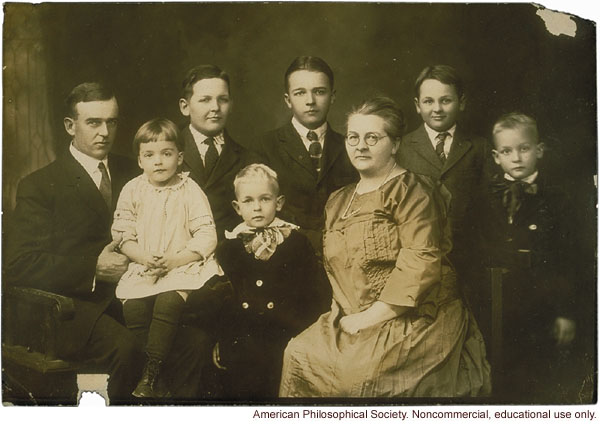
No, it isn't.  Though broken families are the norm in America, therapists and researches would argue that the single-parent family is a far cry from the committed opposite-sex parents' family called "traditional."  Overwhelming research shows that young men whose father was absent in their rearing are more likely to abandon their own children than those young men who were raised by a mother and father in the picture.  (This information is so widely known and inarguable that I won't even bother linking a source.)

And what about the child who is raised without a mother?  If not having a father affects a child in some way, not having a mother affects him in another. 
Hair parted, ties neat, and one serious matriarch.  Not a coincidence.
Now, this should give us pause.  A child raised in a family of two same-sex committed parents is still likely raised either (a) without a mother or (b) without a father.  And since we know that these situations affect a child, usually for the worse, it is utterly false to say that any kind of family is just as good as another.

Obviously, my line of thinking has been simplified for blog format, and much more could be said.  But should one take an honest, common sense look at the statement, "Love is love.  Family is family," regardless of what they hope or feel or wish to be true, he or she must come to a similar conclusion . . . or else argue against rationality itself.


7 Quick Takes: Volume 3

--1--


Did you hear?  Angelina Jolee and Brad Pitt are getting married.

I'm not an avid follower of pop culture, but I admire them as a refreshingly non-materialistic version of the Hollywood couple.  They do a ton of charity work, give millions of dollars, and have six kids--the last scores very highly in my book.

When previously asked why they didn't marry, they admitted that they already lived like a married couple and that they had decided not to marry until all people had the "right" to legally wed.

But their children, in the clear-sightedness typical of that mysterious young species, recognized that acting like they were married is not a satisfying substitute for actually being married.  Their innocence profoundly affected their parents, who now are admitting that they believe marriage will be a beautiful commitment to add to their stores of devotion for each other.

Wouldn't it be something if this huge, Hollywood family became Catholic?

--2--


We finally bought the baby some shoes!  Sandals, to be precise.  They have two straps on them that both velcro so that they are virtually adjustable, which is just what we need.  His little feet are shaped like very steep wedges of cheese.  It's a wonder how he manages to balance on them!

--3--


I started a supplemental blog to this one.  It's more to house my nonexistent writing career literary endeavors with a focus on fairy tales and by extension, myths and legends.  I'm excited about it.

--4--


Maybe you've heard of this, or maybe you haven't.  Joseph Pearce, a prolific non-fiction writer who taught me to better appreciate Oscar Wilde, has published two books now showing the evidence for William Shakespeare's Catholicism, through what we know of his biography and through his plays.  Professor Pearce is incredibly clear-headed, erudite, and professional.  Pair that with a profound faith, and you find me kicking myself that I didn't transfer to Ave Maria University when I considered it in my sophomore year of college.


--5--


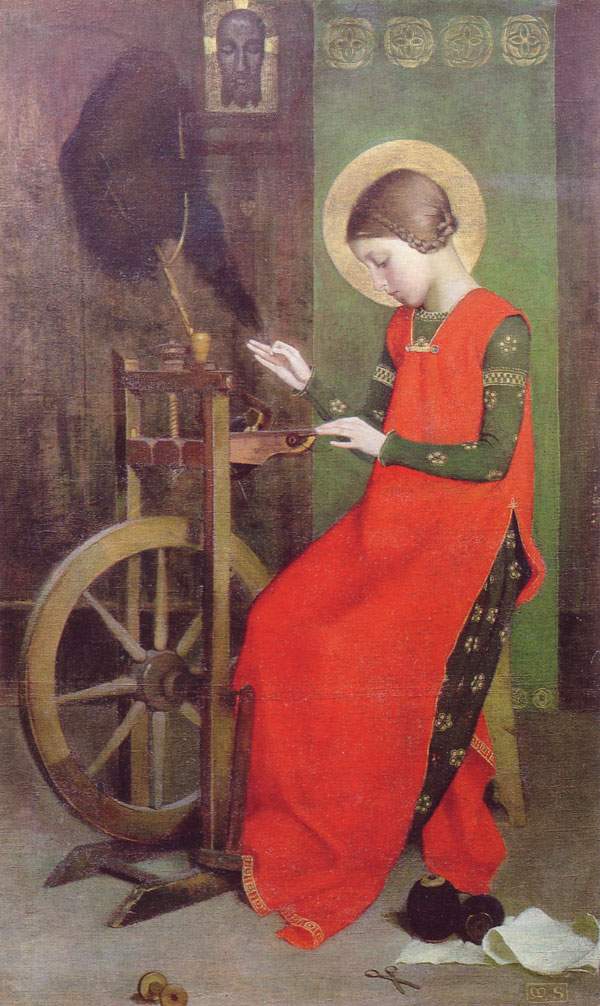
The title image for Spinning Straw into Gold is taken from a painting of Saint Elizabeth of Hungary "Spinning for the Poor" tweaked in Photobucket, by Marianne Stokes.  Beautiful, isn't it?


--6--


This song never fails to move me.


--7--


It's officially summer.  I swelter the minute I step outside, no matter what time of day or night.  And you know what that means--beach days!  Look for adorable baby-in-the-sand pictures in the following weeks and months.

You know you want to.